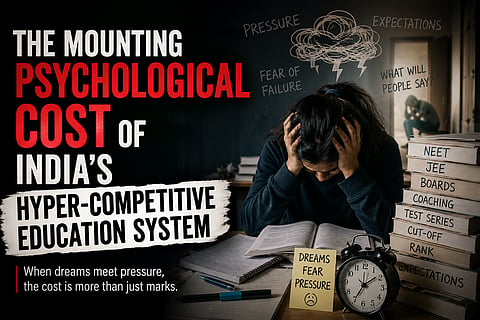


India's competitive examination ecosystem has long been regarded as a pathway to social mobility and professional success. However, the recent NEET-UG 2026 paper leak controversy has once again exposed the immense psychological burden carried by millions of students preparing for high-stakes entrance examinations.
According to reports by The Times of India, at least 12 NEET aspirants reportedly died by suicide during the 37-day period between the cancellation of NEET-UG 2026 on May 12 and the retest held on June 21 following a suspected paper leak. The students, all of whom were due to appear for the re-examination, belonged to states including Rajasthan, Uttar Pradesh, Madhya Pradesh, Tamil Nadu, Gujarat, Uttarakhand, Maharashtra, Goa and Delhi. Accounts from families and police pointed to stress, uncertainty and the emotional toll associated with the cancelled examination and the impending retest.
Beyond the immediate controversy, the incidents have renewed concerns about student mental health and the intense pressure embedded in India's highly competitive education system.
"As a NEET aspirant, we go through a lot of social pressure. People often tease us and make fun of us for spending years trying to crack an exam. To prepare, we spend entire days alone in a room or library, studying by ourselves. We don't have much of a social life or time with friends. We rarely go out or spend time with them. All of this significantly increases the pressure. The stress keeps building up inside us and eventually bursts out at some point," says Maya, who has been preparing for the examination for the past two years.
For many aspirants, the pressure extends beyond the examination itself. The fear of disappointing parents, failing to justify financial sacrifices and falling short of societal expectations often becomes overwhelming.
"I felt that the guilt of not living up to our parents' expectations and the money they invest in us can drive some children to end their lives. Even a single disappointing word or look can hurt deeply while preparing for a competitive examination," says Dilna K., who appeared for the NEET retest after her fourth attempt.
The experiences of students reveal a deeper societal issue. From a young age, many children are conditioned to believe that certain careers and courses are inherently superior to others. Medicine, engineering and a handful of prestigious professions are often portrayed as benchmarks of success, while alternative career paths are viewed as secondary. Consequently, academic performance becomes closely tied to self-worth and social acceptance.
The structure of competitive examinations further intensifies this burden. Years of preparation, sacrifices and sleepless nights are often judged within a matter of hours. Success or failure in a two or three hour examination can determine educational opportunities and shape future career trajectories.
Importantly, poor performance in these examinations does not necessarily indicate a lack of preparation or ability. Many students struggle to effectively demonstrate what they have learned under immense stress and anxiety. The high-pressure environment can impair concentration, affect decision-making and undermine years of hard work.
The deaths of NEET aspirants during the recent controversy serve as a reminder that competitive examinations are not merely academic events, they carry profound emotional and psychological consequences. As India continues to rely heavily on high-stakes examinations for admissions and career advancement, the need to address student mental health, reduce stigma around failure and broaden societal definitions of success has become increasingly urgent.
The challenge before policymakers, educational institutions and society at large is not simply to reform examinations, but to build an ecosystem where ambition does not come at the cost of emotional well-being and where every student's worth is recognised beyond a rank or score.
