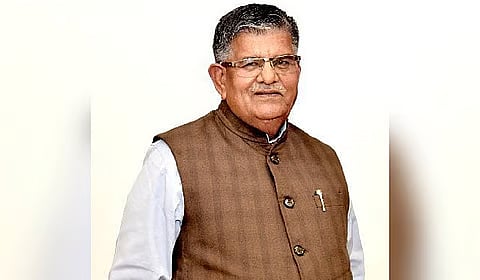

Punjab Governor and UT Administrator Gulab Chand Kataria has called on universities to make artificial intelligence (AI) an integral part of higher education, research and innovation, while ensuring that its adoption remains ethical, inclusive, human-centric and socially responsible.
Addressing a conference of university vice-chancellors on “Artificial Intelligence and Higher Education” at Punjab Lok Bhavan on Saturday, Kataria said the rapid growth of AI was reshaping the way people learn, work, conduct research and make decisions. He described AI as a transformative technology that could have a far-reaching impact on India’s economy and society in the decades ahead.
Kataria said AI education should not remain confined to engineering and computer science departments. Instead, universities should promote multidisciplinary learning, with AI applications being explored across fields such as medicine, agriculture, law, finance, languages and social sciences.
He also urged institutions to develop AI-driven solutions for pressing challenges in areas including agriculture, healthcare, water conservation, governance and environmental protection.
The conference opened with an introduction to the theme by educationist and former Guru Nanak Dev University (GNDU) Vice-Chancellor Jaspal Singh Sandhu. UT Administration Director, Sports, Sorabh Kumar Arora, delivered a presentation on “MY Bharat – Mera Yuva Bharat.”
The technical session on “The Future of Technical Education with the Advent of AI” was addressed by K K Aggarwal, President of South Asian University (SAU), New Delhi, former Chairman of the National Board of Accreditation (NBA) and founding Vice-Chancellor of Guru Gobind Singh Indraprastha University.
Rajeev Ahuja, Director of IIT Ropar, along with his team, discussed emerging AI technologies and their applications in higher education.
Vice-Chancellors Suresh Kumar of Shaheed Bhagat Singh State University, Pushpinder Singh Gill of Maharaja Bhupinder Singh Punjab Sports University and Vinay Goyal of CGC University shared institutional best practices.
A special address by Lovely Professional University (LPU) Professor and Additional Director Harpal Thethi highlighted the importance of stronger university-industry linkages and the need to equip students with skills that match evolving industry requirements.
Kataria further called for universities to establish AI laboratories, introduce bridge courses and certification programmes, and expand opportunities for reskilling and hands-on learning. He also highlighted initiatives and frameworks including the National Education Policy (NEP) 2020, IndiaAI Mission, BharatGen, Anusandhan National Research Foundation (ANRF) and One Nation One Subscription (ONOS).
While advocating wider adoption of AI, Kataria cautioned universities about emerging risks related to data privacy, cybersecurity, deepfakes, misinformation, transparency and accountability. Students, he said, must be taught not only what AI is capable of doing, but also where its use should be limited.
He emphasised that universities have a critical role in preparing India’s young population for an AI-driven future and in contributing to the country's broader goal of building a Viksit Bharat by 2047.

