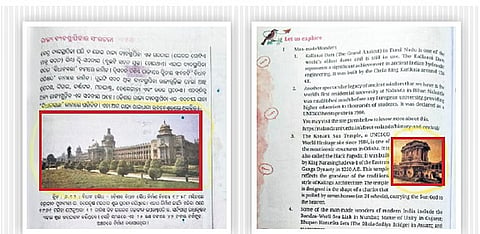

BHUBANESWAR: The state government on Friday suspended the former director of Teachers Training and State Council of Educational Research and Training (SCERT) and three assistant directors while initiating disciplinary proceedings against six other officers for the massive errors in the school textbooks published for Classes I to VIII under the National Education Policy (NEP) framework.
Manoj Padhi, who was the director of SCERT when the textbooks were finalised, is currently serving as a special secretary in the Higher Education department. Three assistant directors of SCERT Pralipta Mishra, Dilip Kumar Sahu and Bharati Tudu were also placed under suspension for the lapses.
Disciplinary proceedings have been initiated against six other assistant directors - Bandita Pattnaik, Manas Ranjan Rout, Manoranjan Mohapatra, Prashant Kumar Sahu, Manas Kumar Nayak and Sudarshan Santara.
The action was taken on the basis of the inquiry report submitted by the committee headed by development commissioner DK Singh to Chief Minister Mohan Charan Majhi earlier in the day. Accepting the committee’s recommendations, Majhi directed stringent action against the officials and also approved a series of corrective measures.
The government had constituted the three-member committee after a staggering 1,678 factual, typographical and printing errors were detected in school textbooks across subjects, triggering massive outrage in the state.
As per the recommendations, the government has decided to implement all 14 recommendations of the committee aimed at strengthening textbook preparation, review and publication mechanisms and preventing recurrence of such errors. Among the immediate measures, SCERT has been directed to publish a master errata register within seven days and distribute printed correction sheets to all students, the chief minister’s office (CMO) said.
Replacement pages or reprinted inserts will be provided in cases involving serious errors, while corrected PDF versions of textbooks will serve as the official teaching material until revised editions are printed. The panel also recommended orientation programmes for teachers to familiarise them with the corrections and preparation of a responsibility matrix to fix accountability for every error detected in the textbooks.
To institutionalise quality control, the government will establish a Textbook Quality Assurance Cell within SCERT and create subjectwise Curricular Area Groups and book-wise Textbook Development Committees on the lines of NCERT.
The recommendations further include introduction of a four-stage proofing system and a final locked PDF mechanism before books are sent for printing, besides creation of a public errata portal for reporting and tracking errors.
The committee has also proposed penalties, performance scoring and blacklisting provisions for erring printers and DTP vendors, as well as mandatory pilot testing of all new textbooks before large-scale publication.
It has stipulated that no textbook in future will be cleared for printing without final academic, language, factual, illustration and production clearance.
This story has been written by Sudarsan Maharana of The New Indian Express.

