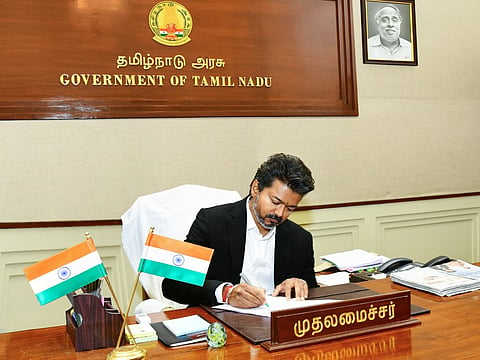


The formation of the new Tamil Nadu government under C Joseph Vijay has drawn attention not only because of the actor-turned-politician’s rise to power, but also because of the educational and professional backgrounds of several members of his cabinet and legislative team.
The 2026 government led by Tamilaga Vettri Kazhagam includes ministers and MLAs with qualifications in engineering, law, medicine, management, statistics and public administration. Political observers note that the composition of the cabinet has led to discussions on the role academic qualifications play in governance and policymaking.
Ministers and MLAs with diverse academic backgrounds
According to details shared by the party and publicly available profiles, the 108-member TVK legislative team includes PhD holders, postgraduates, IIT engineers, MBBS doctors, and several members with professional backgrounds in law, medicine and administration.
Among the prominent members is CTR Nirmalkumar, elected from Thirupparankundram, who holds degrees in engineering, law & criminology and police administration.
P Venkataramanan, elected from Mylapore, has academic qualifications in commerce, business administration and law.
S. Keerthana, one of the youngest legislators in the Assembly, holds degrees in Mathematics and Statistics.
T K Prabhu, elected from Karaikudi, is a dentist with advanced qualifications in dental sciences.
Another senior member, K G Arunraj, is a former Indian Revenue Service officer and medical graduate.
Aadhav Arjuna, who has worked in political consulting and sports administration, holds a degree in political science from Madras Christian College.
Education and politics in India
Educational qualifications have not traditionally been the primary measure of political leadership in India. Across states and political parties, leaders with varying academic backgrounds have held major offices and led governments.
Political experience, organisational skills, public engagement and understanding of local social realities have often played a larger role in electoral success and governance.
At the same time, changing policy challenges involving technology, healthcare, economics, digital governance and infrastructure have increased discussions around the importance of specialised knowledge in public administration.
Some experts believe ministers with professional or technical backgrounds can bring better subject knowledge into governance and policymaking. At the same time, political experts and studies by organisations such as the Centre for the Study of Developing Societies point out that governance is not based only on educational qualifications. They say effective leadership also depends on public understanding, political experience, communication skills and the ability to manage issues at the grassroots level.
A broader public discussion
The composition of the TVK cabinet has contributed to a wider public conversation on whether educational qualifications should play a greater role in political leadership.
The debate is not entirely new. Over the years, discussions around the educational backgrounds of elected representatives have surfaced periodically in Indian politics, especially during elections and cabinet formations.
However, political scientists and election studies by organisations such as the Centre for the Study of Developing Societies have often pointed out that academic qualifications alone do not determine administrative success. Indian politics has seen leaders from diverse educational backgrounds govern effectively at both the state and national levels. At the same time, several highly educated leaders have also held key positions in public life. Former Prime Minister Manmohan Singh was an economist with degrees from University of Oxford and University of Cambridge, while former President A. P. J. Abdul Kalam was an aerospace scientist. Shashi Tharoor holds a doctorate in international relations, and Subrahmanyam Jaishankar has a PhD in international relations. Political experts note that governance often depends on a mix of education, administrative ability, political experience and public connect.
Governance beyond degrees
As the new government begins its term, attention is likely to remain on how the cabinet translates its professional and academic backgrounds into governance outcomes.
Ultimately, the effectiveness of any government may be assessed less by the degrees held by ministers and more by policy implementation, administrative efficiency and public welfare outcomes.
Whether higher academic qualifications influence governance in a meaningful way is likely to be judged over time through the functioning of the government and its impact on people’s lives.
