
Devdutt Pattanaik’s latest book, Escape the Bakasura Trap: Let Contentment Fuel Your Growth, sets itself an ambitious target.
It claims to take a closer look at the consumerist culture we are currently entrapped in, weighing it against contentment that enables personal growth and liberation from the relentless hunger, fear, and insecurity that drives many of us.
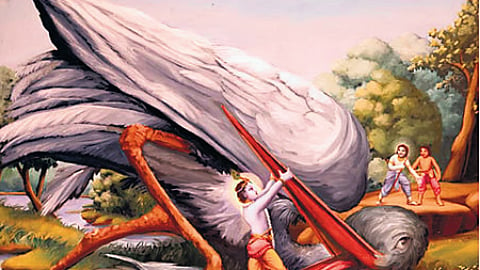
Drawing on Bhima’s slaying of the perpetually hungry demon, Bakasura, Pattanaik unravels the path towards liberation first revealed by Hanuman.
In order to escape human enslavement to pleasure and greed, which accrues karmic debt, ensuring the soul is caught in the endless cycle of birth and rebirth, the Hanuman endorses kindness and detachment to achieve salvation.
The aim of the book is a lofty one, and one can’t help but agree with Pattanaik’s detractors who have accused him of oversimplifying complex philosophies of the epics, stripping them of nuance and providing readers with a superficial narrative, lacking in depth, richness, and insights.
He urges the reader to “approach this book with curiosity, not combat”, clearly anticipating criticism and making a perfunctory and ineffective effort to deflect it. Reading the book makes for a disconcerting experience, as Pattanaik hastily sketches out his purpose and proceeds to string together corporate buzzwords with scant regard for anything close to coherence.
His thoughts and ideas, bordering on the idiosyncratic, are haphazardly put together, leaving the reader wondering whether his editorial team was asleep or outsourced the job to AI, resulting in an output that is riddled with glitches and gaffes.
Sample this: “All humans need food, clothing, and shelter. But only Muslims need mosques, and the Japanese need sushi. And all of us have that one hunger that is unique to us, and for which we seek no companion.”
One is forced to stop and uncover the senselessness of such heedless statements, carelessly designed to provoke. Does Pattanaik mean to assert that Hindus, Christians, and followers of other religions don’t need temples, churches, and places of worship?
Outside the polarising world of social media, don’t tourists feel the need to visit churches, Buddhist stupas, synagogues, and temples for assorted purposes ranging from religious awe, interest in historical monuments, to arresting Instagram backdrops?
Doesn’t sushi count as food that not only the Japanese but people from every part of the globe consume? Where exactly is he going with this and the numerous other non-sequiturs that went into the making of this book?
This is quite disappointing from someone like Pattanaik, whose commendable body of work on the contemporary relevance of Indian mythology is a formidable one, which has made the vast universe of Vedas, Upanishads, Puranas, and Itihasas more accessible to those seeking to explore the fathomless depths of these texts without being overwhelmed.
The book has stories and characters from Puranic lore, but there is very little meat on its bare bones. It appears to be mostly a tiresome exercise in generating content for corporate consumerism while claiming to be escaping it. The irony seems to be lost on the author, who ought to have known better than to make this attempt to commodify myth and cater to crass commercialism. As he himself puts it, “We use stories to increase the value of goods and services of the same measure. We call it branding.” Looks like the corporate gods will be pleased
It is quite disappointing from someone like Pattanaik, whose commendable body of work on the contemporary relevance of Indian mythology is a formidable

