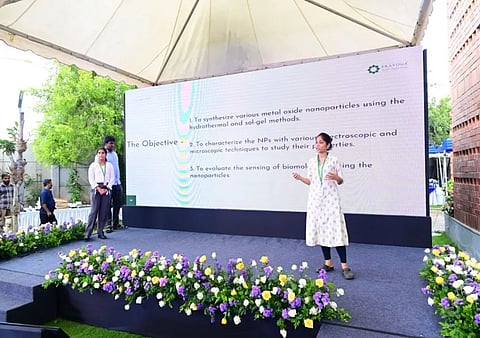

Shambhavi Das, an Anveshana 2025 student researcher from Prayoga Institute of Education Research, has won the Best STEM Presentation Award at the International Young Researchers’ Conference (IYRC) 2025, hosted by Columbia University. Competing with participants from more than 20 countries, Shambhavi emerged as the only award winner from India among the six awards presented at the conference.
An 11th-grade student, Shambhavi participated in the virtual edition of the conference held recently. Her work was carried out as part of Anveshana 2025, Prayoga’s flagship national student research program, under the mentorship of Dr. Ramya Prabhu (Principal Investigator) and Ms. Swetha N (Co-Principal Investigator). Along with fellow student researchers Aadya and Shashank, she worked on the project titled “Synthesis of Metal Oxide Nanostructures by Solution-Based Chemical Method for Sensing of Biomolecules.”
Taking their research to the international stage, Shambhavi presented their study titled “Biosensing of Dopamine using Titanium Dioxide Nanoparticles,” which was recognised with the Best STEM Presentation Award. The research involved synthesising titanium dioxide (TiO₂) nanoparticles using the sol–gel method and analysing their properties using techniques such as X-ray diffraction (XRD), UV–Diffuse Reflectance Spectroscopy (UV-DRS), Fourier Transform Infrared Spectroscopy (FTIR), Field Emission Scanning Electron Microscopy (FESEM), Transmission Electron Microscopy (TEM), Thermogravimetric Analysis (TGA), and Brunauer–Emmett–Teller (BET) surface area analysis. Using an electrochemical workstation, the team then evaluated the nanoparticles’ ability to detect dopamine in an electrochemical sensing system.
Dopamine is a neurotransmitter that regulates mood, motivation, and behaviour, and abnormal levels are associated with several neurological conditions. Detecting dopamine accurately and efficiently is therefore important for medical diagnostics and research.
Shambhavi’s research explored whether extremely small particles of titanium dioxide could act as sensitive detectors for dopamine. The study demonstrated that these nanostructures can help identify dopamine in a chemical system, highlighting the potential of nanomaterial-based sensors for future biomedical diagnostic tools that could enable faster and more precise detection of neurological conditions linked to dopamine imbalance.
Speaking about her experience, Ms. Shambhavi Das said, “Presenting our research at an international conference alongside students from across the world was an incredible learning experience. The mentorship at Anveshana helped me understand how to ask scientific questions, design experiments, and communicate findings effectively. Winning this award is truly encouraging and motivates me to pursue research further.”
Anveshana, India’s first fully funded scientific research program for high school students (Grades 9–12), offers students the opportunity to pursue original research under expert mentorship. The program brings together students from diverse backgrounds and provides access to advanced laboratories and fieldwork while also serving as Prayoga’s education research initiative to study how research nurtures scientific temperament.
Shambhavi’s recognition at the international conference underscores the growing impact of the program in enabling high school students to undertake original research under expert guidance and equipping them with skills required for advanced research environments.

