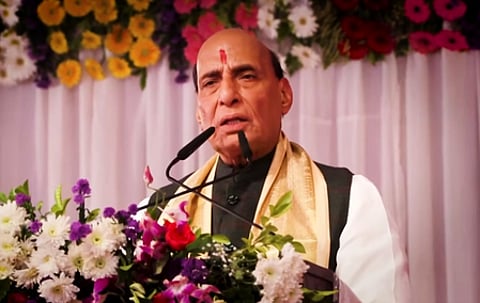

New Delhi, Nov 13 (IANS): Defence Minister Rajnath Singh on Friday advised governments that instead of only focussing on how to win the next election, they should think about how to secure the future of the next generation in India.
"For us, a 'Viksit Bharat' does not merely mean a five-trillion-dollar economy. While that is certainly an important component, our vision for a 'Viksit Bharat' is far broader," Rajnath Singh said while addressing an event to mark 90 years since the establishment of the Brahma Kumaris and 72 years of its spiritual services in Lucknow.
He explained that 'Viksit Bharat' signifies a nation where citizens are honest, families are rooted in values, society lives in harmony, women are respected, the youth are disciplined, and every individual possesses a sense of duty towards the nation.
"In our decision-making, we should not just look at the political gains we might derive; rather, we should consider the benefits to society. Don't think about how to win the next election, think about how to make the future of the next generation better. The true essence of politics lies in conducting governance through policy and morality. Politics is not merely a means to attain power; it is a tool to provide direction to the future of society and the nation," the Defence Minister stated.
Further, Rajnath Singh cautioned that if politics is perceived only as a arena for competition, mutual accusations, and personal ambition, the youth will distance themselves from it.
"However, if they see the potential for service, nation-building, character development, and social transformation within politics, they will undoubtedly engage with it," he said while emphasising that the youth are not just the future of this country, but also its present.
"The future of a nation does not simply emerge out of nowhere at some point in the future—it is shaped today. It is shaped by the efforts made today. In essence, the seeds sown in the present determine the fruits reaped in the future," he stressed.
Moreover, Singh advised youngsters to focus on building character along their careers and use technology responsibly. He urged the youth to seek information without losing their power of discernment, and to engage with the world while remaining firmly connected to their own roots.
"Being modern and forgetting one’s cultural identity are two different things; one must learn to distinguish between them," he stated.
"Success which merely enriches an individual’s own life—without providing any direction to society—remains limited in its value. Young people should not focus solely on building a career; they must pay equal attention to building their character," he added.
The Defence Minister further said that when one observes a shortcoming in society, rather than merely criticise it, one should also take responsibility to address it.
"This is the perspective that transforms an ordinary youth into a responsible citizen, and a responsible citizen into a participant in nation-building. If today’s youth cultivate wisdom alongside knowledge, restraint alongside strength, empathy alongside success, and a spirit of service to the nation alongside ambition, then our resolve to transform India into a developed nation will surely be realised," he said.
Noting that spiritual development is not just a path toward personal liberation, but also a pathway for building national character, Rajnath Singh said: "Elections may be won or lost, but I will do what is right and nothing else. Politics can achieve its real purpose only when ethics and spiritual consciousness are associated with it. I call this the spiritualisation of politics."
Explaining the spiritualisation of politics, Singh said it did not mean linking politics to any particular religion, sect or practice. Instead, it meant connecting public life with universal values such as ethics and duty.
—
This report was published from a syndicated wire feed. Apart from the headline, the EdexLive Desk has not edited the copy.
