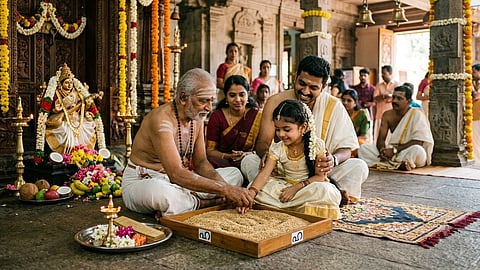


A child places a finger on a plate of rice and carefully traces their first letters under an adult’s guidance. This is the central ritual of Vidyarambham, a ceremony observed in Kerala on Vijayadashami, the final day of Navaratri.
On Wednesday (October 21), temples and cultural centres across Kerala welcomed families with youngchildrenfor the annual ceremony. Politician Shashi Tharoor, who performed Vidyarambham for children, described the occasion as deeply moving and spoke about Kerala’s long-standing attachment to literacy and education.
“Vidyarambham is an extremely special occasion in Kerala. It happens the morning after Vijayadashami. I always find it a very moving occasion because it shows the importance of learning and education in Kerala’s culture. People here have always been extremely attached to literacy, and that is why Kerala was the first state in India to achieve almost universal literacy,” he said.
Also known as Ezhuthiniruthu in Malayalam, Vidyarambham marks a child’s introduction to letters and is associated with the worship of knowledge and learning. How did this custom originate, and how did it become an enduring part of Kerala’s cultural and educational heritage?
What does Vidyarambham mean?
The word Vidyarambham comes from the Sanskrit words vidya, meaning knowledge or learning, and arambha, meaning beginning. The ceremony marks a child’s first formal introduction to written letters.
During the ritual, an adult guides the child’s hand as they write on rice spread across a plate. The phrase “Hari Sree Ganapathaye Namaha” is commonly used in Kerala. In certain traditions, the first letters are also written on the child’s tongue with a gold ring.
The ceremony is associated with Saraswati, the Hindu deity of knowledge, learning, music and the arts. Families who observe the ritual seek blessings for their children’s education and future.
Tracing the history of Vidyarambham
Establishing the exact origins of Vidyarambham is difficult. The ceremony belongs to a wider tradition of religious and cultural practices associated with education in India, but historical evidence does not establish when the present-day ritual first began.
Traditional Indian education included oral instruction, memorisation and the study of religious and literary texts. Children learned under the guidance of teachers, with methods varying according to the period, region and educational tradition.
Ancient Indian customs also included rites associated with different stages of life and learning. Vidyarambha, a ceremony marking the commencement of education, appears in later descriptions of religious practices. However, the available evidence does not establish a precise date for the origin of the Kerala observance or confirm that its present form has remained unchanged over the centuries.
Vidyarambham is best understood within this wider cultural history, with its specific customs developing through regional religious and educational traditions.
Why is Vidyarambham observed on Vijayadashami?
Vijayadashami marks the conclusion of Navaratri, a festival during which Saraswati is worshipped in several Indian traditions. In Kerala, the day is considered auspicious for beginning educational pursuits.
Children may be introduced to reading and writing, music, dance or other art forms during the occasion. Priests, teachers, writers and other respected individuals often guide them through the ceremony at temples and cultural institutions.
One prominent venue is Thunchan Parambu in Tirur, Malappuram district. Associated with Thunchath Ezhuthachan, a major figure in Malayalam literary history, the site houses the Thunchan Memorial Trust and Research Centre. Families gather there for Vidyarambham each year, connecting the ceremony with Kerala’s literary heritage.
The observance also takes place at numerous temples and other venues across the state, making Vijayadashami an important date for families wishing to mark the beginning of their children’s education.
What does Vidyarambham mean for children today?
For a young child, Vidyarambham can be an early experience of forming letters with an adult’s help. Parents may regard the occasion as a milestone in their child’s education, while the ritual itself gives cultural significance to the first steps towards literacy.
Learning to read and write develops through regular practice, conversation, storytelling, play and suitable educational activities. A single ceremony cannot determine a child’s readiness for school or predict their progress in learning.
Vidyarambham marks the beginning symbolically; the child’s education continues through everyday experiences, classroom learning and guidance from family members and teachers.
The practice continues to connect education with family traditions and Kerala’s cultural life. Its central act remains simple: an adult guides a child through their first letters, marking the start of a journey that will continue long after the rice has been cleared from the plate.
