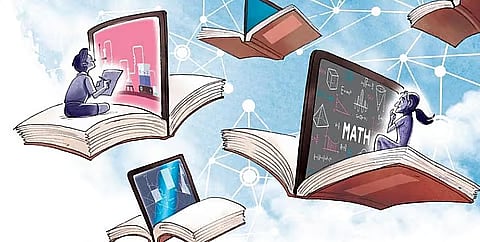

New Delhi: Unless high-quality digital learning becomes affordable and universally accessible, technology risks amplifying existing socio-economic inequalities rather than reducing them, educationist Shishir Jaipuria said, warning that students from rural and low-income backgrounds continue to face structural disadvantages in the rapidly evolving education landscape.
Speaking to PTI, Jaipuria, the Chairman of Seth Anandram Jaipuria Group of Educational Institutions, said while India's push towards digital learning, AI-enabled classrooms and online education platforms has expanded access to quality education, significant gaps remain in affordability, connectivity, language and teacher availability.
"Unless high-quality digital learning becomes affordable and universally accessible, technology risks amplifying existing socio-economic inequalities rather than reducing them," he said.
Jaipuria noted that students in smaller towns and economically weaker households often lack access to digital devices, stable internet connections and quality online coaching resources, which are increasingly becoming essential for competitive examination preparation.
"Another disadvantage for students from rural backgrounds is the persistent shortage of qualified teachers. A significant number of schools continue to operate with only one or two teachers teaching multiple grades and subjects," he said, calling for greater efforts to recruit, train and retain teachers in underserved regions.
According to the educationist, India's digital education initiatives have played a crucial role in democratising learning opportunities.
With internet connectivity reaching most villages and platforms such as DIKSHA and SWAYAM expanding access to educational content, technology has the potential to bridge learning gaps if implemented inclusively.
However, affordability and language barriers remain major concerns.
"The challenges of affordability and language are not peripheral but central to educational equity in India," Jaipuria said, adding that while India has among the world's cheapest mobile data rates, internet usage in rural areas still lags significantly behind urban centres.
He said the dominance of English in digital learning ecosystems often limits access for large sections of students and stressed the need for greater integration of Indian languages.
Advances in artificial intelligence-powered translation and transliteration tools could help overcome this challenge, he underlined.
Jaipuria also expressed concern over the growing influence of short-form digital content on children's learning habits and attention spans.
"Technology can be a great force multiplier if leveraged with discretion. Excessive consumption of social media and short-video content is affecting attention span, critical thinking and social-emotional development among young people," he said.
The trend, he said, is contributing to declining concentration levels, reduced interest in deep learning and weaker critical-thinking abilities among students.
On reviving reading habits, Jaipuria emphasised the importance of strengthening literacy from the foundational years through structured reading programmes, libraries and teacher-led initiatives.
"Those who learn to read in their formative years read to learn and evolve for the rest of their lives," he said, adding that educators and school leaders must themselves model reading behaviour to encourage students to view reading as a lifelong habit rather than merely an academic requirement.
As AI becomes increasingly embedded in education, Jaipuria said schools should teach students to use AI responsibly and ethically while ensuring that technology complements rather than replaces human thinking.
"Teachers must continue to be facilitators who encourage students to question, analyse and create. Our aim should not be to replace thinking with technology, but to use technology to deepen thinking and innovation," he said.
This report was published from a syndicated wire feed. Apart from the headline, the EdexLive Desk has not edited the copy.

