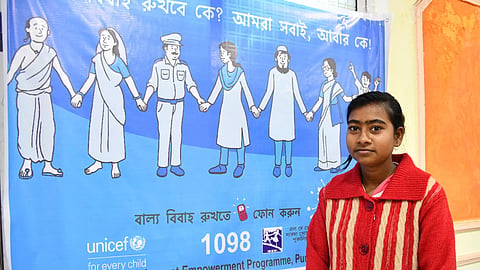


The United Nations has praised India’s efforts to combat child marriage and strengthen the rights of girls, with officials highlighting the role of education, government initiatives and community participation in improving their prospects.
The remarks were made at an event titled ‘Investing in Girl Child – Transforming Our Future’, co-hosted by the Permanent Missions of India and Sierra Leone to the United Nations on October 12 to mark the International Day of the Girl Child. The discussion focused on education, health, protection and economic opportunities for girls.
UNICEF Deputy Executive Director Hannan Sulieman said India’s experience demonstrated how sustained investment and community engagement could bring “real, meaningful change”. She said the country’s progress mattered beyond its borders, given its population of 253 million adolescents.
“When girls thrive, societies thrive,” Sulieman said, emphasising the connection between girls’ opportunities and wider social development. She attributed the decline in child marriage in part to coordinated government and community action, including the campaign for a child-marriage-free India.
Education and community action key to reducing child marriage
India’s Permanent Representative to the UN, Parvathaneni Harish, highlighted the Beti Bachao Beti Padhao programme as an example of efforts to address social biases, improve welfare delivery and increase girls’ school enrolment.
“Investing in the future of the girl child delivers unmatched compounding returns,” Harish said. He argued that girls’ education can raise the age at which they marry, improve their skills and expand access to employment and financial independence.
Harish also linked women’s and girls’ health to broader development outcomes, saying improved healthcare access can reduce infant mortality and contribute to economic growth.
Sierra Leone’s Deputy Minister for Foreign Affairs and International Cooperation, Jeneba Bangura, warned that denying girls education, forcing them into early marriage or limiting their opportunities through gender discrimination had consequences for society as a whole.
“When a girl is denied education, forced into early marriage, or held back by gender bias, we lose her potential,” Bangura said. She added that an educated, healthy and protected girl could transform her own life as well as those of her family and community.
Child marriage remains a concern in India
UNICEF defines child marriage as a formal marriage or informal union involving anyone below 18 years of age. The organisation warns that the practice can violate children’s rights and expose them to violence, exploitation and abuse, with girls disproportionately affected.
“Child marriage ends childhood,” UNICEF says on its India programme page, noting that it can undermine children’s rights to education, health and protection.
UNICEF estimates that at least 1.5 million girls below 18 marry in India each year, while nearly 16% of adolescent girls aged 15 to 19 are currently married. The organisation’s programme page records a decline in the prevalence of girls marrying before 18, from 47% in 2005-06 to 27% in 2015-16. These figures refer to the periods specified by UNICEF and should not be read as current annual estimates.
The organisation identifies improved access to education, increased literacy among mothers, legislation, public awareness and government investment in adolescent girls among the factors that may have contributed to the decline. It also points to poverty, gender inequality and social norms that limit girls’ choices as continuing barriers.
UN representative flags gender gap in technology
The discussion also turned to women’s representation in technology and the safety of girls online. Harish recalled that his mechanical engineering class had once been entirely male because the discipline was considered suitable for men. He said the growing participation of women in engineering showed that social attitudes could change.
He also raised concerns about the gender imbalance in artificial intelligence and its potential influence on the development of emerging technologies.
“How can we make the cyber domain a safe space for women and girls?” Harish asked, calling for greater attention to online safety and more inclusive technology. He said digital public infrastructure could also help expand educational opportunities for girls.
UNICEF’s recommendations for adolescent empowerment include keeping girls in secondary education, improving their health and nutrition, delaying marriage beyond the legal age and helping them develop skills that can lead to economic independence. Its approach brings together education, health, nutrition and child protection rather than treating child marriage as an isolated issue.
