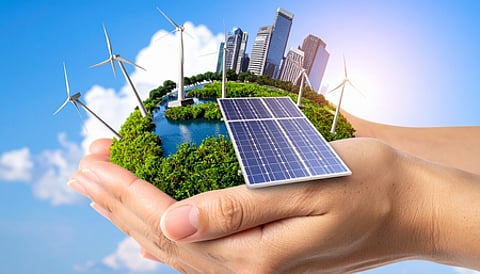
New Delhi, Sep 3 (IANS): Green hydrogen could transform the European Union’s Carbon Border Adjustment Mechanism (CBAM) from a trade challenge into a driver of low‑carbon industrial growth and deeper India‑EU value chains, a new report has said.
Green hydrogen could also catalyse trade competitiveness, energy security and sustainable prosperity, the report from European Times said, adding that India and the EU are entering a phase in which trade, industrial competitiveness and climate policy are increasingly linked.
The publication argued that the success of the clean industry partnership will be measured in installed electrolysers, contracted tonnes of green hydrogen, commissioned H₂‑DRI plants and recognised carbon certificates — not just by number of declarations signed.
"With breakthroughs in India and Europe’s clean energy ecosystem by the end of this decade, the energy transition could become more than a climate project. It could become the foundation for a new, cleaner and more competitive India–EU industrial partnership," the report said.
The conclusion of EU‑India free trade agreement talks in January 2026 provided a platform for closer economic ties, with bilateral goods trade currently near 136 billion, and India running an estimated $15 billion surplus.
CBAM, which entered its definitive regime on January 1, 2026, covers iron and steel, aluminium, cement, fertilisers, electricity and hydrogen and places a carbon cost on embedded emissions in covered imports.
The mechanism creates a powerful incentive for producers outside Europe to cut their carbon intensity, but poses a particular challenge for India given the centrality of steel to its industrial expansion.
India’s economic development will require a dramatic expansion of steel, cement, chemicals, transport and infrastructure and the country's National Steel Policy envisages crude‑steel capacity of 300 million tonnes and production of 255 million tonnes by 2030–31.
Green hydrogen could serve as the bridge between objectives of both countries, the report argued, adding that India’s enormous renewable-energy potential and growing industrial base offer an opportunity for Europe to build new clean-technology supply chains.
Rather than expanding conventional capacity for steel production and then retrofitting it, the publication suggested India to increasingly build clean industrial capacity from the outset.
“Green hydrogen is particularly important because it can replace fossil fuels in industrial processes that are difficult to electrify directly,” the publication said.
India aims to establish 5 million tonnes per annum of green-hydrogen production capacity by 2030.
Nearly 15 companies have been awarded 3,000 MW per year of electrolyser manufacturing capacity, while 18 companies have received incentives covering 8,62,000 tonnes per annum of green hydrogen production capacity.
—
This report was published from a syndicated wire feed. Apart from the headline, the EdexLive Desk has not edited the copy.

