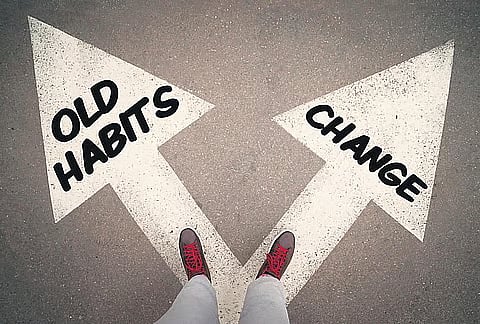

Unlearning refers to the intentional act of discarding obsolete knowledge, beliefs, or behaviours which limit one’s ability to adapt and evolve. The purpose behind unlearning is to update one’s internal framework to better align with present and future demands.
There are different ways one might unlearn something in light of new information. The first is a straightforward refutation of the old idea. Other times, new knowledge revises a simpler picture by filling it with more complex details. This can look like simply adding new knowledge, but there is some unlearning involved because the older, simpler view is getting replaced by a fuller one, with more details. In all of these cases, however, one has to first let go of something they thought they understood to make way for a new understanding.
One challenge when it comes to unlearning is that when something contradicts one’s current understanding, they are likely to dismiss it. This may be adaptive in a world where much of what people say, or the information one encounters, is false or deliberately constructed to manipulate.
Another great challenge of unlearning is that most of the doubtful assumptions about the areas that impact one’s life are never examined. Although they drive how one functions, they aren’t actively reflected upon. As a result, they maintain their full force, even if fairly simple arguments could overturn them.
One way to begin unlearning is to seek additive knowledge in familiar areas and use that new knowledge to start modifying old knowledge. This approach calls for a lot of patience with theory than most people have an appetite for. Another approach is to seek other people’s experiences of the world. Travel can be a potent form of unlearning. A third approach is to be more varied and bold in one’s experiments in life, which can open up many avenues that were previously out of reach.
A good meta-belief to have in one’s unlearning endeavour is to be comfortable with the idea that everything one knows is provisional, and that underneath that is likely a more complex and strange picture. The thrill of finding a new and more accurate way of looking at things then starts to eclipse the aversion to uprooting a previously stable way of thinking.
Being open to unlearning opens the door to new perspectives. It trains the mind to pause, reflect, and revise, instead of reacting from old assumptions. As that habit deepens, it becomes easier to release emotions that corrode one’s inner world and to respond with more clarity, steadiness, and care. In the end, the power of unlearning lies in its promise that change is always possible.

