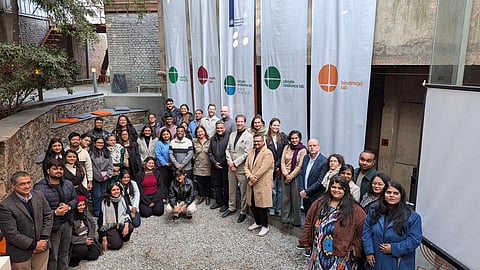

Design institute The Design Village (TDV) has partnered with Delft University of Technology (TU Delft), Netherlands, to launch the Water & Design Studio, a new academic and research initiative.
As the name suggests, the studio is focused on developing solutions for water, design and climate resilience. The collaboration, supported by the Embassy of the Kingdom of the Netherlands in New Delhi, will operate under the Climate Resilience Lab at TDV.
The studio aims to examine water as a political, environmental and social force amid the growing impacts of climate change.
With regions across the world facing erratic rainfall, rising sea levels and increasing pressure on water infrastructure, the programme seeks to explore how design-led research can help interpret and respond to changing water ecologies, a press release announcing the development informed.
According to TDV, the initiative brings together design education, scientific inquiry and cultural research.
It will involve collaborative work across India and the Netherlands through a research framework titled Flowing Futures, which uses ethnography, field studies and speculative design to understand how communities interact with water in different contexts. These include rural and agricultural settings, urban infrastructure, river systems and coastal regions.
Mudita Pasari, Academic Dean at The Design Village, said that the launch of the Water & Design Studio marks a key step in a long-standing partnership between TDV and TU Delft.
“The work at the studio will allow us to envision more balanced and inclusive futures, mindful of human and beyond-human perspectives," she said, adding that the collaboration reflects ongoing efforts to address shared challenges related to climate resilience and water-centric disasters.
Also commenting on the collaboration, Dr Roy Bendor, Associate Professor of Critical Design at TU Delft’s Department of Human-Centred Design and Director of the Design for Interaction master’s programme, said that the initiative would expand existing educational exchanges by adding a stronger design research component.
“The water and design lab will open a path for experimenting with cultural differences, be they spiritual or practical, a matter of history or of future aspirations, as a way to redesign how we live and manage water both in India and in the Netherlands,” De Bendor added.
The Water & Design Studio will also function as a platform for academic exchange between the two institutions, enabling interdisciplinary collaboration across design, engineering and social research.

