
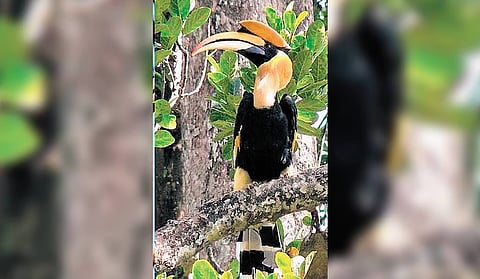
Tamil Nadu to survey hornbill population across three Kovai tiger reserves
COIMBATORE: As part of the state government’s Hornbill Conservation Initiative, launched in March 2025, a population survey of four hornbill species will be conducted across all ranges of three tiger reserves and parts of the Coimbatore forest division in the coming weeks.
The survey is expected to be completed by the end of March or the first week of April next year, after which the exact population of these species will be known.
A senior forest department official said the first phase of the survey would be carried out in the Anamalai, Srivilliputhur–Megamalai and Kalakkad–Mundathurai tiger reserves, along with the Karamadai and Mettupalayam forest ranges in the Coimbatore forest division.
“These areas have been identified as hornbill presence zones. The assessment aims to estimate the population and density of hornbills. The survey will commence at the end of December and continue until the end of March or the first week of April 2026, coinciding with the hornbill breeding season. In the second phase, similar exercises will be undertaken in other parts of the state,” the official said.
Four hornbill species are found in these areas — the Great Hornbill, the Malabar Grey Hornbill, the Indian Grey Hornbill and the Malabar Pied Hornbill. While the breeding season of the Great Hornbill may extend until May, that of the Malabar Grey Hornbill ends in April.
The survey will be carried out by field staff along with biologists and researchers using the line transect method, covering a few kilometres in identified hornbill habitats daily. As part of the initiative, scientists from the Nature Conservation Foundation (NCF) recently imparted training to forest staff at Attakatty near Valparai on identifying hornbill species, nesting sites and understanding their food habits.
“Similar to methodologies adopted for assessing other wildlife species in Tamil Nadu, we will follow line transects and direct observation, including identification through calls. This approach has yielded good results during previous assessments in hornbill-bearing areas of the Anamalai Tiger Reserve,” said an NCF scientist, which is collaborating with the forest department on the initiative.
The lifespan of smaller grey hornbills ranges between 15 and 16 years, while the Great Hornbill can live up to 20 years. All hornbill species are frugivores and consume fruits from over 100 species of trees in the Western Ghats. Often referred to as ‘feathered foresters’, they play a crucial role in seed dispersal through droppings, aiding forest regeneration. Male hornbills also bring animal prey such as lizards, small birds, bats and insects to feed chicks during the nesting period.
“An interesting aspect of hornbill ecology is that they nest in hollows of large trees and reuse the same nests year after year. Therefore, protecting mature trees with hollows is a key focus of the Tamil Nadu Hornbill Conservation Initiative,” the official added.
