
Many find a certain appeal in adventures, especially chasing the highs of trekking. But not all who do find themselves up for the task of trekking up Mount Kilimanjaro — the world’s highest freestanding mountain, located in Tanzania, Africa. This is largely because the trek involves climbing high altitudes, mostly without allowing one a day to rest, and the summit day can entail 15 hours of trekking upto 1,000 m in elevation where one will only have half the oxygen level that is normally available at sea level.
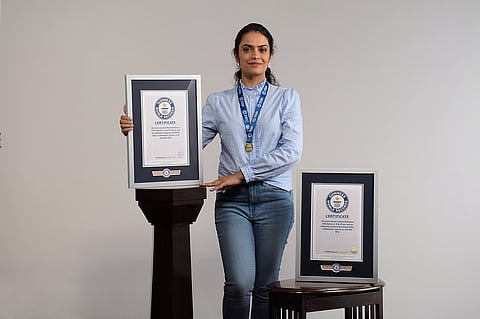
But Jayashree Vijay Mohan, who has been recovering from a stroke since 2021, geared up to climb this mount a few months ago. Determined to expand the definition of recovery and resilience, she ended up creating not one, but two Guinness World Records — Fastest Ascent in five days and 6.5 hours and Fastest Descent in 10.26 hours, in the CIH (Coordination Impairment – Hemiplegia) Female category.
Now, four months later, reflecting on her feat, she says she does not wish to contain her story’s overarching theme to be “overcoming adversity for applause”, but rather hopes it resonates with reclaiming confidence and agency after a life-altering event. Even if it doesn’t inspire, she hopes her record is a challenge for other women, especially stroke survivors, to break.
Jayashree who juggles different roles including being a mother and a business entrepreneur, opens up about her recovery, and the climb. Excerpts follow:
How do you remember and perceive the things that were happening around you while you were at the hospital after the stroke?
I suffered a stroke that left my left side paralysed and altered my balance, speech, and cognition. The hospital phase comes back to me in fragments. Not dramatic, but deeply unsettling. I was fully aware of what was happening around me, yet my body felt entirely unfamiliar. The hardest part was not the diagnosis itself. It was seeing the confusion in my children's eyes. They could not understand why their mother was away and visiting multiple hospitals undergoing various therapy sessions. As a parent, that helplessness stays with you in a way nothing else does. What also stayed with me was something the doctors said early on: that certain neurological damage could not be completely reversed. Recovery stopped being about returning to who I was before and became about understanding who I could become now.

How did the recovery reshape your understanding of strength compared to how you defined it before the stroke?
Before the stroke, I believed strength meant pushing harder. Doing more. Enduring more. After the stroke, I understood that strength can also mean restraint. It means listening to your body, respecting its limits, and continuing forward.
After surviving a stroke, what was the moment you realised you wanted to climb mountains and what made that decision feel possible?
There was no grand announcement. It was a quiet internal shift that happened gradually. During rehabilitation, I kept asking myself what moving forward truly meant. One day, I realised I did not want my story to end at survival. I wanted it to include growth. Mountains had always been symbolic for me. Kilimanjaro became less about altitude and more about agency. It felt possible not because my body was fully ready, but because my mindset had changed. Accepting my condition gave me the clarity to attempt something ambitious again. Acceptance, I discovered, is not the end of ambition. It is where ambition begins.
You went through months of intense preparation, including over 40 injections and structured rehab. What part of that journey tested you the most?
The most difficult part was not the injections or the physical fatigue, though those were real. It was the mental comparison, constantly measuring myself against who I used to be. Balance issues led to frequent falls. Cognitive changes meant forgetting words mid-sentence. The pace of improvement was slow, and on many days, frustratingly invisible. But I learned to shift my measure of progress.
Tell us a little about your philosophy, 'Avlo Daan'.
When I say ‘Avlo Daan’, it does not mean I agree with what happened to me. It means I stop spending energy resisting what cannot be changed. Once I could truly accept the situation, I was free to look forward and ask what was still possible. That is where the definition changes. It became the thing I said to myself at the start of every day. These words were my power pill and I grounded my entire belief system on it.
What has the mountain taught you about making decisions?
It has taught me clarity matters far more than certainty. You make decisions based on the best information available to you at that moment, and you accept the risk consciously. You do not wait for the risk to disappear, because it never will. In business, in motherhood, and on the mountain, the principle is the same. Assess honestly, accept the constraints, and move with conviction. Waiting for guarantees is often just another name for never beginning.
This story has been written by Nidharshana Raju of The New Indian Express.
