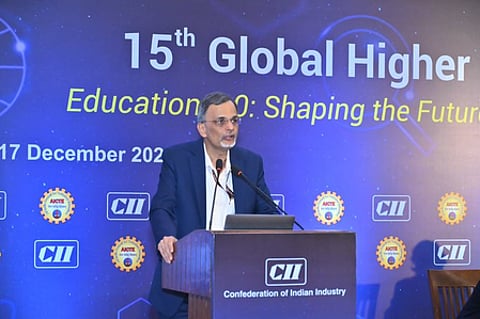

India is at a demographic and economic turning point, and higher education will play a critical role as millions of young people prepare to enter the workforce over the next two decades, Chief Economic Adviser (CEA) V Anantha Nageswaran said yesterday, Wednesday, December 17.
“States hold the key to the next phase of higher education reform in India,” he said at a Confederation of Indian Industry (CII) event in New Delhi, Deccan Chronicle reports.
The CEA also emphasised the importance of resolving teacher shortages immediately through methods such as professors of practice, as well as increasing educational quality.
Nageswaran went on to say that other significant tasks for states include shifting from control to stewardship, transitioning from input-based to outcome-based regulation, embracing an entrepreneurial approach to public administration, and financing institutions based on differentiated responsibilities and outcomes.
“Whether this demographic dividend becomes a growth accelerator or a social strain will depend in large measure on the quality, relevance, and adaptability of our higher education system,” he said.
Nageswaran added that the policy groundwork for this has been laid through the National Education Policy 2020 (NEP 2020), and mindset changes in higher education regulation. “What is now required is execution, institutional courage and cooperative federalism,” he said.
The CEA also advocated for greater industrial involvement in curriculum development, research, and governance.
"Industry can co-design curricula, offer credit-bearing internships, support applied research, share infrastructure, and participate meaningfully in governance," he stated.
Further, he added that collaboration among the government, states, industry, and citizens can help India transition from scale to leadership and become a global powerhouse for education, research, and ideas.
