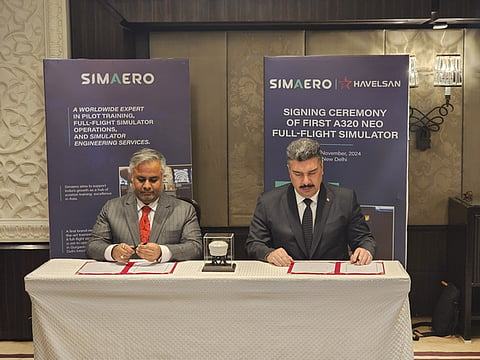

New Delhi (PTI): French company Simaero, which has set up its simulator training facility in India, plans to tap the country's local engineering talent in the specialised areas of simulator engineering and technology services.
In a recent interview with PTI, Simaero's CEO Nicolas Moute said the company's long-term vision was to build a centre of excellence for aviation training that serves not only India but the wider South Asian region.
"We are very optimistic about India. Every market has its challenges, but we see far more opportunities than obstacles," he said, adding that the company does not see any barriers that would prevent it from expanding its presence in the country.
At the training facility in Gurugram, Haryana, the company recently launched its first Airbus A320 neo simulator and expects to add one or two more simulators in the near term, based on customer demand.
"We could possibly expect to add a Boeing or regional ATR aircraft simulator. However, it would depend on our client's requirements.
"Over the next five years, our objective is to operate between four and six simulators at this facility while also establishing at least one satellite training centre elsewhere in India," Moute said.
Simaero, which owns and operates 21 simulators, has more than 300 clients across 80 countries, and has training centres in different countries, including France and South Africa.
"One of the biggest advantages India offers is its highly skilled workforce. We see tremendous potential in developing local engineering talent, particularly in specialised areas such as simulator engineering and technology services," Moute said.
The company also has plans to transfer knowledge and technical expertise to India. It undertakes complex work such as simulator upgrades, software integration, visual system enhancements, server replacements and simulator relocations.
"We will train local engineers ourselves, working closely with our experienced teams from France, South Africa and other global centres...we expect our workforce to grow significantly, with Indian engineers taking on increasingly sophisticated responsibilities," the Simaero CEO said.
While the Indian aviation market has been expanding with more aircraft and increased flight networks, there are challenges in pilot training capacity.
A significant proportion of training for pilots from India happens overseas.
To a query on the impact of Artificial Intelligence, Moute said AI is becoming an increasingly important part of aviation training, particularly in improving operational efficiency and enhancing the overall learning experience.
"AI has the potential to make these training programmes more efficient by helping analyse training data, personalise learning pathways and optimise simulator utilisation.
"It also supports more effective planning and scheduling, allowing airlines to make better use of both instructors and training capacity," he said.
At the same time, Moute stressed that AI is designed to complement and not replace the expertise of instructors and proven training methodologies.
In 2024, Simaero announced that it would make a total investment of 200 million euros in India in the next ten years for the training facilities.
This report was published from a wire feed. Apart from the headline, the EdexLive Desk has not edited the copy.

