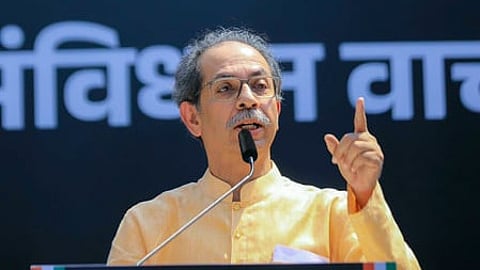

Mumbai, Oct 27 (IANS): The Shiv Sena Uddhav Balasaheb Thackeray on Tuesday stepped forward to defend youth activists embroiled in a sharp legal and public debate over the enforcement of "peace bonds" during anti-government demonstrations in New Delhi.
The Thackeray camp, in an editorial in the party's mouthpiece, 'Saamana', asserted that executing a peace bond is neither an apology, a surrender to state authorities, nor an admission of guilt.
The controversy stems from recent 'Tiranga' demonstrations organised in defiance of strict bans across major protest venues in the national capital, including Jantar Mantar. Following their arrest, police required Cockroach Party youth leaders -- identified as Abhijeet Dipke, Saurabh Das, Ashutosh Ranka, and Ajinkya Shinde -- to sign peace undertakings to secure their release, said the editorial.
In contrast, activist Neha Bora refused to sign similar undertakings and challenged the practice in court. The Delhi High Court subsequently issued directives stating that authorities cannot demand a peace bond until an ongoing inquiry concludes and a full police report is submitted, noting that no formal bond had been lawfully demanded from Bora in that manner, added the editorial.
According to the editorial, the split approach drew comment from former Supreme Court judge Justice Markandey Katju, who publicly praised Bora for her defiance while sharply criticising the youth leaders who signed the undertaking, framing their compliance as a major strategic risk for democratic movements.
Pushing back against Justice Katju's criticism, the editorial mounted a detailed legal defence of the young activists, emphasising that peace bonds are strictly preventive measures rather than punitive actions, citing the landmark Supreme Court precedent in the Madhu Limaye case. "Signing a peace bond does not equate to issuing an apology, kneeling before the government, or confessing to a crime. It is merely an undertaking to maintain peace; it does not enforce absolute silence or legally prevent citizens from participating in public demonstrations," remarked the editorial.
The editorial highlighted the governing statutory framework under the Bharatiya Nagarik Suraksha Sanhita (BNSS). Former Section 107 of the IPC (now Section 126 BNSS) serves as an undertaking to maintain peace without stripping citizens of their fundamental rights under Article 19 of the Constitution to hold peaceful assembly and protest. Under former Section 122 of the IPC (Section 141 BNSS), police officers hold no unilateral authority to declare a bond violated. Any alleged breach must be formally proved before a magistrate. If a breach is established before a magistrate, the legal consequence is strictly limited to simple imprisonment for a maximum of one year for the remainder of the bond duration, along with forfeiture of the specified bond amount.
In the conclusion, the Uddhav Thackeray-led Shiv Sena urged young citizens fighting for democratic freedoms not to be intimidated by procedural mechanisms used by law enforcement. The party also called on senior legal figures, including Justice Katju, to actively guide and encourage emerging youth leaders rather than penalising their tactical decisions in court.
—
This report was published from a syndicated wire feed. Apart from the headline, the EdexLive Desk has not edited the copy.

