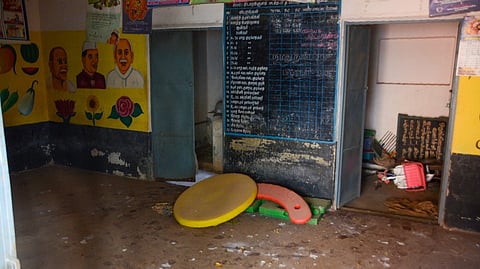


Rajasthan has linked 61,524 of its 62,136 Anganwadi centres with government schools, achieving 99% coverage under its school integration initiative. Six districts, including Alwar, Bhilwara, Churu, Kota, Sikar and Deeg, have reported near-complete or 100% integration, according to the latest data from the Poshan Tracker.
Of the centres linked to schools, around 26,000 operate physically within school premises, while nearly 35,000 are mapped to nearby institutions. The state counts centres located close to schools as integrated even when they do not share the same campus.
Under the mapping criteria, Anganwadi centres within 500 metres of a government school in urban areas and within one kilometre in rural areas are linked to that school.
Bharatpur has recorded 88.01% integration, while Balotara stands at 92.11% and Salumbar at 92.99%. These are among the districts with comparatively lower coverage.
The initiative seeks to improve coordination between Anganwadi workers and school teachers, particularly in early childhood care and education (ECCE). A teacher at the linked school is assigned as a mentor to guide Anganwadi workers in delivering preschool education.
“Co-location helps to ensure continuity in children’s education after Anganwadi. A school teacher is also given charge as a mentor to guide Anganwadi workers in early childhood care and education (ECCE),” a state official said.
The arrangement is expected to make the transition from preschool to Class I easier for children and reduce the likelihood of them dropping out before entering formal schooling. Schools and Anganwadi centres can also share facilities such as toilets, drinking water and play areas.
Closer coordination is expected to support children's nutrition, health check-ups, growth monitoring and immunisation. Anganwadi workers provide supplementary nutrition and preschool education to children below six years, alongside health and nutrition services for pregnant women and lactating mothers.
Rajasthan's Economic Review 2025-26 recorded 11.90 lakh children aged three to six as beneficiaries of preschool education across approximately 62,000 Anganwadi centres. It also documented an earlier phase of school integration, when 42,554 centres were linked with government schools. Of these, 22,746 operated on school premises and 19,808 were located within a 700-metre radius of schools.
The latest Poshan Tracker figures reflect a higher level of integration under the current mapping criteria. The two sets of figures use different reporting periods and distance parameters.
The state has also been expanding preschool facilities through Balvatikas. According to the Economic Review, 962 Balvatikas were operational in Mahatma Gandhi English-medium schools and another 629 in PM SHRI schools.