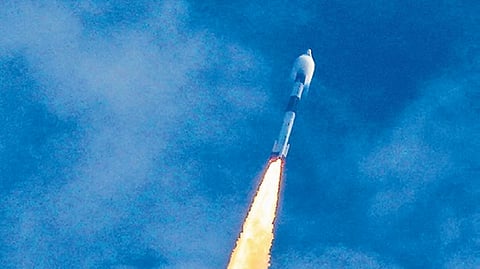

BENGALURU: The most-awaited first commercial satellite launch of 2026 by the Indian Space Research Organisation (ISRO) -- the PSLV-C62 carrying EOS-N1 and 15 other satellites -- failed to reach its designated orbit on Monday.
The rocket deviated from its designated path towards the end of the third stage separation. The satellite earlier took off from the first launch pad of Satish Dhawan Space Centre, Sriharikota on Monday. Though it was cloudy and there was a light drizzle, it did not impact the launch at 10.18 am.
Until the third stage separation of the rocket, there was loud cheering, as if to negate the bad memories of the failure of the PSLV-C61 mission on May 18, 2025. Then, the mission had failed during the third stage separation when there was a drop in the chamber pressure during firing of the engine.
Failure noted after 425 seconds: ISRO team
The tension in the space centre was palpable when the computer screens tracking the rocket started to show errors. The vehicle started showing errors from 378th second of the launch and after 425 seconds the failure was noted. The rocket had then reached 374Km into orbit.
ISRO Chairman V Narayanan said, “The PSLV-C62/ EOS- N1 mission was attempted. The four stage vehicle had two solid and two liquid stages. The performance of the PSLV up to the third stage, the solid stage, was as expected. During the end of the third stage, we saw disturbances in the vehicle. Deviations from its designated flight path were observed. We are collecting and analysing data from all the ground tracking stations.”
This the second consecutive failure of the PSLV, termed the workhorse of ISRO. It has been used in 63 flights in the past, including Chandrayaan-1, Mars Orbiter Mission, Aditya-L1 and Astrosat Mission. In 2017, the PSLV had also set a world record of launching 104 satellites in a single mission.
Monday’s mission was important as it carried the EOS-N1 satellite developed by the Defence Research Development Organisation (DRDO), also called as Anvesha. The advanced Earth Observation Satellite (EOS) was designed for strategic defence and civilian purposes.
It also included 15 commercial satellites from India and overseas -- EOS jointly built by Thailand and the United Kingdom, CGUSAT AND DSUSAT Technology Demonstration by University Students by Dhruva Space, MOI-1 satellite built by Dhruva Space and Takeme2Space, Thybolt-3 by Dhruva Space, LACHIT by Dhruva Space and Don Bosco University, Munal by Antharkshya Pratishthan (Nepal) and Indian Ministry of External Affairs, Sanskar Sat built by Laxman Gyanpith (India), AyulSat by OrbitAid (India) and Kestrel Initial Technology Demonstration (KID) Capsule -- the re-entry capsule, Edusat, Uaisat, Galaxy Explorer, Orbital Temple and Aldebaran-1 built by AlltoSpace (Brazil).
This was the 64th flight of PSLV and fifth mission of PSLV-DL variant. The mission was also to demonstrate KID from a Spanish startup, which is a small-scale prototype of a re-entry vehicle being developed by the startup. KID was slated to be the last co-passenger satellite to be injected, after which it was slated to re-enter the earth’s atmosphere towards splashdown in the South Pacific Ocean.
The ISRO team had also aimed to inject EOS-N1 and 14 co-passenger satellites into a Sun Synchronous Orbit and the KID Capsule into a re-entry trajectory. After injection of EOS-N1 and 14 satellites, ISRO had aimed for the fourth stage where the satellite was to be re-started to de-boost and enter a re-entry trajectory, followed by KID Capsule separation.

