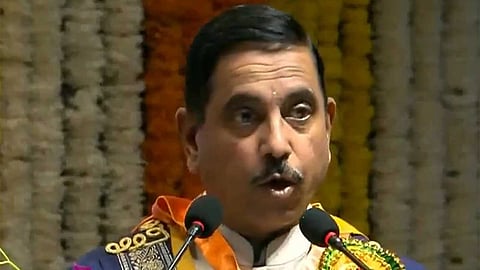

Union Education Minister Pralhad Joshi on Tuesday called for a shift from rote learning and an excessive focus on examination scores to experiential education, saying the pressure to secure marks often comes at the expense of students’ understanding, confidence and individual interests.
Speaking at the inauguration of the Central Board of Secondary Education’s (CBSE) Experience Centre at its integrated office complex in Dwarka, New Delhi, Joshi also called for expanding the facility and ensuring that students from economically disadvantaged families could access it.
“Much of a student's time goes into memorising and planning how to score marks. Parents, too, often feel the marks must be scored somehow,” Joshi said, describing the prevailing attitude as “marks-wadi”.
“The cost is that a child's understanding, learning capacity and interests go unexamined,” he said, adding that knowledge that remains in books and cannot be applied when needed serves little purpose. He linked the approach to the objectives of the National Education Policy (NEP) 2020.
The minister also connected the emphasis on marks with the growing importance of coaching centres, arguing that students were increasingly being pushed towards memorisation and examination preparation rather than the practical application of what they learn.
CBSE Experience Centre: 12 zones, 21 exhibits
Spread across 6,000 square feet, the CBSE Experience Centre houses 12 broad zones and 21 exhibits designed to take visitors through the evolution of education in India, from traditional learning systems to contemporary classrooms, digital education and emerging career opportunities.
The centre includes a section tracing CBSE’s history through photographs and archival material, including records dating back to 1935. Other exhibits cover scientific concepts, the history of the Earth, future professions and career exploration.
The facility also uses interactive technology, including RFID-enabled smart cards that allow visitors to engage with exhibits and access personalised takeaways. Its exhibits are intended to give students opportunities to explore concepts and subjects beyond conventional textbook-based instruction.
The centre follows a proposal for an AI-powered digital experience facility that was considered by CBSE’s governing body in June 2025. The proposal aimed to create a technology-based environment where students could engage with educational content interactively.
Joshi calls for more centres and wider access
Joshi called for the expansion of the Experience Centre, saying the ministry would provide the necessary support. He also stressed that students from poorer families should be able to visit the facility, raising the question of how access to such learning opportunities can be extended beyond students who already have access to well-resourced schools and educational facilities.
Joshi also referred to Atal Tinkering Labs, which encourage students to experiment with science and technology. He said 10,000 such labs were operational and that the government had decided to establish another 50,000.
NEP 2020 and the shift to experiential learning
The NEP 2020 calls for reducing dependence on rote learning and encouraging conceptual understanding, critical thinking, creativity and problem-solving. It also places emphasis on experiential learning, competency-based education and vocational exposure.
Under a competency-based approach, students are expected not only to recall information but also to apply what they have learnt to unfamiliar situations and practical problems. Classroom activities, experiments, projects and discussions can help teachers assess whether students understand a concept rather than simply memorise an answer.
Interactive exhibits and educational visits can introduce students to new subjects, but sustained change also depends on teacher preparation, classroom practices and assessment methods.

