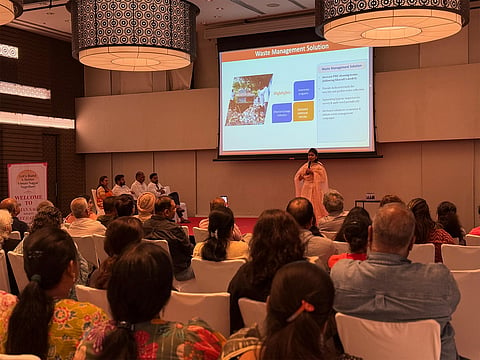

Pune: With the Pune Municipal Corporation (PMC) elections approaching, a noticeable shift is emerging in the city's political landscape. In pockets such as the posh areas of Viman Nagar, Lohegaon and Wagholi under Ward No. 3 of the PMC, traditional campaign slogans and street-corner speeches are gradually giving way to presentations, charts and timelines, signalling a new style of electioneering driven by highly educated, professional candidates.
At the centre of this evolving trend are Aishwarya Pathare and Surendra Pathare, BJP candidates with strong business and professional backgrounds, who have introduced a "corporate-style manifesto" that mirrors boardroom strategies more than conventional political rhetoric. The manifesto, presented through structured documents and PowerPoint-based briefings, outlines time-bound goals, outcome-driven solutions, and measurable governance benchmarks.
Speaking to ANI, Aishwarya Pathare, a professional engineer and entrepreneur, said, "Rather than listing generic assurances, the manifesto focuses on execution. It details plans to address long-pending civic challenges in Lohegaon, Wagholi and Viman Nagar, including infrastructure gaps, traffic congestion and unplanned urban expansion. Proposals include road widening to ease traffic bottlenecks, strengthening public transport connectivity, regulating unauthorised construction and ensuring the delivery of basic civic amenities through planned development."
A key element of the campaign is its emphasis on transparency and accountability. The candidate has committed to sharing progress reports with residents every six months, a practice more commonly associated with corporate project management than political office. Campaign meetings feature data-backed presentations, project timelines and performance indicators, offering voters a clearer picture of how promises would be implemented.
Political analysts see this as a reflection of changing voter expectations in urban centres like Pune, where a growing population of IT professionals, entrepreneurs and young voters are seeking governance models that prioritise efficiency and measurable outcomes over emotional appeals.
"The idea is to treat governance as professional management," Surendra Pathare, BJP candidate and engineer from Ward No. 4, said during interactions with residents, underscoring the belief that politics should move beyond speeches and focus on delivery.
The approach has found traction particularly among educated urban voters, with social media amplifying discussions around the so-called "corporate manifesto."

