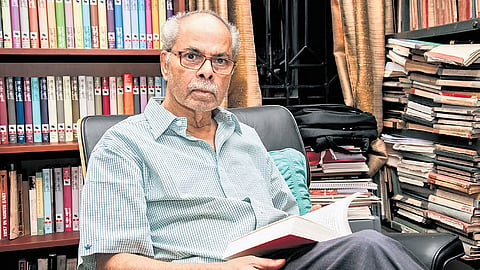

KOZHIKODE: Kandiyoor Narayana Panikkar, the Marxist historian who firmly stood up against every attempt to communalise the discipline and upheld the sanctity of empirical facts, died in Thiruvananthapuram on Monday. He was 89.
Known for his unwavering commitment to secularism, Panikkar adorned numerous important posts, including vice-chancellor of Sree Sankaracharya University of Sanskrit, chairman of the Kerala Council for Historical Research, vice-chairman of the Kerala State Higher Education Council and president of the Indian History Congress. He also served as professor of history and dean of the School of Social Sciences at Jawaharlal Nehru University.
But it was not the positions he held that made Panikkar a respectable figure in academic circles and among the public. He represented the intelligentsia in the country who felt restless about the ‘Sangh parivar’s meddling with history for political gains’. Like many others, Panikkar was disturbed by the attempt to create history from myth. He agreed that myths do contain elements of historical fact, but staunchly objected to the rewriting of history based on ‘communal mythification’.
Panikkar chose to debunk the colonial classification of Indian history as ‘Hindu period’ and ‘Muslim period,’ which he believed continued to influence national historians. He felt that this approach led to the creation of ‘outsider as enemy’ that gained momentum in the recent decades. He always upheld the idea of a plural society and vociferously argued for an approach that is based on facts and not on faith.
Panikkar had campaigned against BJP governments’ attempt to ‘saffronise’ prestigious institutions in the country, including the Indian Council for Historical Research, the Indian Council for Social Science Research, the Centre for Advanced Studies, the University Grants Commission and the National Council for Educational Research and Training.
But he never confined himself to academia. He wrote articles, attended public functions and participated in debates. He handled a variety of topics in his lectures, writings and interviews including the new world order after the fall of the Soviet Union, the hollowness of America’s ‘war on terror’ and the new challenges before the left in the country.
Panikkar authored and edited several books including British Diplomacy in North India (1985), Against Lord and State: Religion and Peasant Uprisings in Malabar (1989), Culture and Consciousness in Modern India (1990), Culture, Ideology and Hegemony -- Intellectuals and Social Consciousness in Colonial India (1996), Communal Threat, Secular Challenge (1997), Agenda for Cultural Action and Other Essays (2002), History as Site of Struggle (2013), and Society and Culture in Kerala.
He chaired an expert committee appointed by the Kerala government to review school textbooks and, in 2010, launched Indian Ruminations, an online portal for literature and journalism.
Born in Guruvayur in 1936, Panikkar completed his bachelor’s degree from Palakkad Victoria College, where he was chairman of the college union. Panikkar did his master’s and PhD from Rajasthan University. He is survived by wife Usha Bhargava, his classmate from Rajasthan University, and their two children, Ragini and Shalini.
Panikkar’s body will be placed at his residence in Jawahar Nagar, Thiruvananthapuram, on Tuesday morning for the public to pay respects. The funeral will be held later in the evening at Shanthi Kavadam.
(With inputs from T’Puram bureau)
The story is reported by MP Prashanth of The New Indian Express

