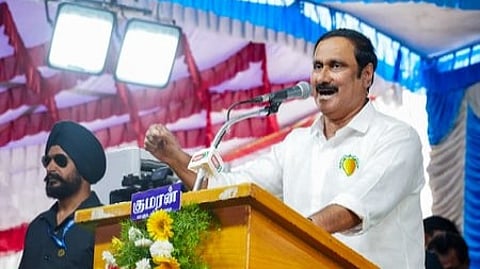


Only 33 of the 650 government-school students admitted to MBBS courses under Tamil Nadu's 7.5% preferential reservation cleared the National Eligibility-cum-Entrance Test (NEET) on their first attempt in 2025-26, prompting Pattali Makkal Katchi (PMK) president Anbumani Ramadoss to demand a review and abolition of the entrance examination.
In a statement, Anbumani cited admission data to question whether NEET was fulfilling its stated objective of ensuring merit-based selection. He said the figures showed that students from economically disadvantaged backgrounds were increasingly having to take the examination multiple times and spend additional years preparing for it.
Of the 650 government-school students admitted under the 7.5% quota across government and private medical colleges, 235 secured admission after their second attempt, 283 after their third, 91 after their fourth and six after their fifth. Two students had appeared for NEET six or more times.
"The remaining 617 students secured seats only after repeated attempts," Anbumani said, referring to the admission figures.
The pattern was also visible among candidates admitted through the remaining 92.5% government quota seats. Of the 8,053 students admitted under this category, 1,613 cleared NEET on their first attempt, while 6,440 had appeared for the examination at least twice.
Anbumani said the 7.5% reservation was introduced in 2020 because government-school students faced disadvantages in competing with candidates who could afford private coaching. He said the fact that 95% of the students admitted under the quota had taken multiple attempts showed that the financial burden of preparation continued to affect these families.
The figures follow a broader decline in first-attempt admissions across Tamil Nadu's medical admission categories. Data from the state's Selection Committee shows that the proportion of government-school students admitted under the 7.5% quota on their first attempt fell from 50% in 2021-22 to 5% in 2025-26. During the same period, the share of first-time entrants under the remaining 92.5% government quota declined from 25% to 20%, while the proportion in the management quota fell from 40% to 30%.
The cost of repeat preparation has also drawn concern. A year of offline coaching can cost between Rs 1.2 lakh and Rs 3 lakh, while online programmes range from Rs 30,000 to Rs 1 lakh. Families may also spend up to Rs 75,000 on crash courses, according to education sector estimates.
Anbumani said the trend raised questions about the promises made when NEET was introduced. The examination was announced in 2010 and made mandatory for undergraduate medical admissions in 2017, with the stated objectives of improving the quality of medical education and curbing commercialisation.
Tamil Nadu introduced the 7.5% preferential reservation through the Tamil Nadu Admission to Undergraduate Courses in Medicine, Dentistry, Indian Medicine and Homoeopathy on Preferential Basis to Students of Government Schools Act, 2020. The provision applies to eligible students who studied in state government schools from Classes 6 to 12 and qualified in NEET. It covers seats under the state government quota, excluding the All India Quota.
The reservation follows recommendations by a commission headed by retired High Court judge Justice P Kalaiyarasan, which examined the barriers faced by government-school students in medical admissions. The commission identified socioeconomic disadvantages, including differences in parental education, occupation and income, as factors affecting their ability to compete.
Anbumani has now called for a review of the NEET system, arguing that the growing dependence on repeat attempts and private coaching has placed additional financial pressure on aspiring medical students.