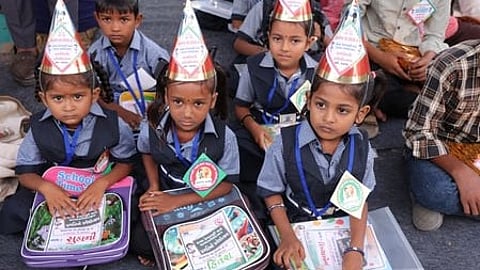

Odisha has operationalised 24 additional Eklavya Model Residential Schools (EMRS) across seven districts, taking the number of functional institutions in the state to 71 and creating residential education opportunities for an estimated 1,440 tribal students.
The state’s ST and SC Development Department announced the expansion on November 17, following the completion of admissions at the newly opened schools. The institutions began operations in October, with the admission process for the 2026-27 academic year subsequently completed.
The new schools are distributed across Mayurbhanj, Keonjhar, Nabarangpur, Sundargarh, Rayagada, Koraput and Kandhamal districts. Mayurbhanj accounts for the largest share, with eight schools, followed by Keonjhar with five and Nabarangpur with four. Sundargarh has three, Rayagada two, while Koraput and Kandhamal have one each.
The eight schools in Mayurbhanj are located at Raruan, Jashipur, Sukruli, Gopabandhunagar, Saraskana, Bisoi, Badampahad and Bijatola. Keonjhar's five centres are at Saharapada, Harichandanpur, Banspal, Ghatagaon and Telkoi.
Nabarangpur's schools are situated at Kosagumuda, Umerkote, Dabugaon and Raighar, while Tangarpalli, Subdega and Bisra account for the three in Sundargarh. The two schools in Rayagada are at Ramnaguda and Padmapur. Padua in Koraput and Tumudibandha in Kandhamal complete the list.
Admission and academic structure
Each of the 24 schools will accommodate 60 students in Class VI, comprising 30 boys and 30 girls, according to the Odisha Model Tribal Education Society (OMTES). The combined intake capacity is 1,440 students.
The schools provide free, English-medium education under the Central Board of Secondary Education (CBSE), with classes extending from VI to XII. Admission takes place through an entrance examination, with eligibility provisions directed at students from economically disadvantaged households.
The state government's 2026-27 admission guidelines specify that students from families listed under the Socio-Economic and Caste Census (SECC) are eligible to apply. Applicants are required to provide income-related documentation, with a stated annual family income threshold of Rs 2.5 lakh where supporting certificates are unavailable.
The Eklavya Model Residential Schools scheme is implemented by the Union Ministry of Tribal Affairs and managed nationally through the National Education Society for Tribal Students (NESTS), in coordination with state-level societies. In Odisha, OMTES oversees implementation.
Odisha's expanding tribal education network
The 24 new institutions add to the 47 EMRS that were already functional in Odisha. The state government's admission guidelines had identified 111 sanctioned schools, while a July 2026 reply in the Rajya Sabha by Minister of State for Tribal Affairs Durgadas Uikey placed the sanctioned total at 114, with 47 functional at the time.
The parliamentary reply also recorded that construction of 62 school buildings had been completed, while 52 were at different stages of construction. The figures indicate the scale of the infrastructure and operational work required to expand the residential school network.
At the national level, 533 Eklavya Model Residential Schools were functional across 25 states and one Union Territory as of November 17, according to figures reported alongside the latest expansion.
The scheme was introduced to provide quality residential education to children from Scheduled Tribe communities, particularly those living in remote and underserved areas. Alongside classroom instruction, its curriculum includes sports, cultural activities, skill development and other co-curricular programmes.
With 24 additional schools now operational, Odisha has expanded its residential education network across several tribal-dominated districts. The focus will now be on ensuring that the new institutions have the teaching staff, residential facilities and academic resources required to sustain their operations.