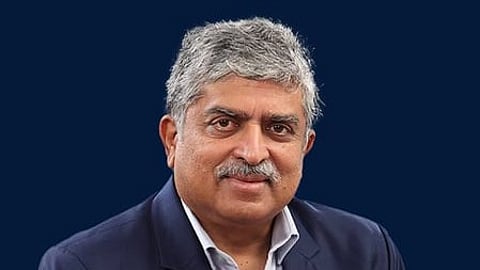

The Centre has extended the deadline for the Nandan Nilekani-led High-Powered Task Force on examination reforms to January 2027, giving the panel more time to complete stakeholder consultations and prepare recommendations for strengthening India's examination system.
The six-member task force has received more than 50,000 suggestions from students, parents, teachers, educational institutions, subject experts, industry organisations and examination-conducting bodies. The panel was initially expected to submit its report by October 2026.
“The stakeholder consultations have been going on. The government has also submitted an affidavit in the Supreme Court listing the progress made by the panel so far. The panel has now been granted time till January 2027 to submit its report,” a source told the Press Trust of India.
The extension comes amid continuing scrutiny of the National Testing Agency (NTA) following examination irregularities and the 2026 NEET-UG paper leak controversy. The task force is examining ways to improve the security, transparency and administration of public examinations, including those conducted by the NTA.
Secure question vault among proposals
One of the proposals under consideration is a secure question vault that would hold a large pool of questions prepared and verified by subject experts throughout the year.
Under the proposed system, questions would be reviewed, checked for accuracy and translated into different languages before being stored in a secure digital repository. Examination papers would then be assembled by selecting questions according to a predetermined blueprint covering the syllabus, question types and difficulty levels.
The panel is also examining the possibility of transmitting encrypted question papers digitally to examination centres shortly before a test begins. The approach is intended to reduce the risk of leaks associated with printing, storing and transporting physical question papers.
The proposals are still under consideration. The panel has yet to submit its final recommendations, and the government has not announced a detailed implementation plan for the proposed question vault.
Another issue under examination is the division of responsibilities among agencies involved in conducting tests. Separating functions such as question-paper preparation, examination-centre management and test administration could reduce the risks associated with concentrating multiple critical tasks with a single service provider.
The Staff Selection Commission already uses computer-based examinations in which questions are selected, compiled and encrypted before being digitally transmitted to centres. The task force is examining how technology and tighter institutional controls could be used to strengthen examination security more widely.
Panel consults previous NEET reform committee
The task force has also consulted former Indian Space Research Organisation chairman K Radhakrishnan, who headed the committee constituted after the 2024 NEET-UG paper leak controversy.
The Radhakrishnan Committee submitted its recommendations in October 2024. Its report contained 101 recommendations covering examination security, the functioning of the NTA, technology, testing infrastructure, candidate verification and student welfare.
Among its proposals were encrypted digital transmission of question papers for printing at examination centres, stronger candidate authentication, more government-run testing centres and improved grievance redressal. It also recommended that the NTA strengthen its internal capacity and reduce its dependence on external agencies for critical functions.
The Centre subsequently established a High-Powered Steering Committee, also headed by Radhakrishnan, to oversee the implementation of the recommendations. The latest examination controversy has renewed questions about the implementation and effectiveness of those measures.
NEET to move to computer-based testing
The Centre has announced that NEET-UG will move to a computer-based test (CBT) format from 2027. The decision marks a shift away from the traditional pen-and-paper examination, which requires the printing, transportation and distribution of question papers across numerous centres.
However, the transition also raises questions about whether enough secure testing infrastructure will be available to accommodate the large number of NEET candidates across the country.
Some officials and experts have suggested considering a hybrid format for NEET-UG 2027 while infrastructure for a full computer-based examination is expanded. Under such an arrangement, the transition could take place in stages, with a complete shift to CBT considered for 2028. This remains a proposal reported during consultations, rather than a confirmed change to the examination format.
Who is on the examination reform task force?
The six-member panel is chaired by Infosys co-founder Nandan Nilekani. Its members are former ISRO chairman S Somanath, former Intelligence Bureau director Tapan Deka, IIT Madras director V. Kamakoti, former education secretary Anita Karwal and logistics expert Amrit Lal Meena.
Prime Minister Narendra Modi announced the task force in July 2026, following student protests over examination irregularities. Its mandate covers examination conduct and security, assessment methods, governance and accountability, technology, infrastructure, accessibility, grievance redressal and student well-being.
In August, the government invited suggestions from candidates, parents, teachers, academic institutions, technology professionals and other stakeholders. The consultation covered both immediate security concerns and longer-term changes to the design and administration of public examinations.
The panel's recommendations are expected to inform the Centre's next steps on examination reform. The key questions will be how the proposed safeguards are implemented, how responsibility is assigned when failures occur, and whether the reforms can prevent leaks without creating new barriers for candidates in regions with limited testing infrastructure.
