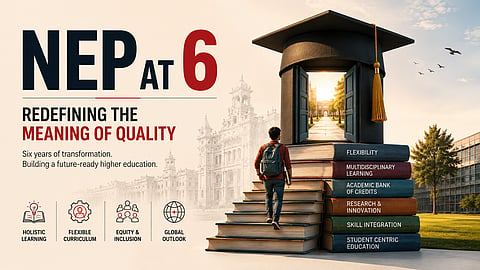

Six years after the rollout of the National Education Policy (NEP) 2020, discussions on the future of higher education centred on balancing academic excellence with ethical values, multidisciplinary learning and community engagement during a special lecture organised at Mahatma Gandhi Antarrashtriya Hindi Vishwavidyalaya (MGAHV), Wardha.
Held under the Akhil Bharatiya Shiksha Samagam 2026 in accordance with the Ministry of Education's guidelines, the programme focused on the role of higher education institutions in preparing students for both professional and social responsibilities.
Delivering the keynote address, Sushma Sharma, Director of Anand Niketan School, Sevagram, said NEP 2020 has brought qualitative and structural changes aimed at making higher education more inclusive, multidisciplinary and student-centric. She said experiential learning, project-based education and community engagement can help develop creativity, leadership, decision-making abilities and a sense of social responsibility among students.
The discussions also highlighted the need to strengthen the Indian knowledge system, multilingual education, environmental awareness, sustainable development and innovation-driven learning. Sharma said higher education institutions should connect local community requirements with national development priorities.
Participants later exchanged views on multidisciplinary education, research and innovation, industry-academia collaboration, skill development and ways to improve students' employability.
Presiding over the programme, Dr Rakesh Kumar Mishra, Head of the Department of Gandhi and Peace Studies, said education should extend beyond imparting knowledge to fostering ethical values, discipline, empathy and social responsibility. According to him, these qualities are essential for nurturing responsible citizens committed to nation-building.
The programme concluded with a vote of thanks delivered by Prof. Manoj Kumar Rai, former Head of the Department.

