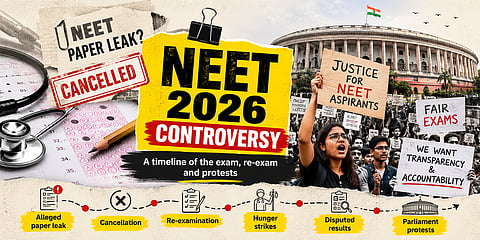


The NEET-UG 2026 controversy has unfolded over several months, beginning with allegations of a paper leak after the medical entrance examination was conducted in May 2026. Since then, the developments have included the cancellation of the original examination, a nationwide re-examination, multiple investigations, student protests, the participation of environmental activist Sonam Wangchuk through an indefinite hunger strike, concerns raised after the declaration of the re-exam results, and the 'Sansad Chalo' march during Parliament's Monsoon Session.
Here's a look at how the controversy unfolded and where it stands now.
What is NEET-UG and why is it significant?
The National Eligibility cum Entrance Test (NEET-UG) is India's single entrance examination for admission to undergraduate medical programmes, including MBBS, BDS and several AYUSH courses. Nearly 20 lakh candidates appear for the examination each year, competing for around 1.37 lakh MBBS seats across government and private medical colleges. As admissions depend on a single examination, any disruption or alleged irregularity attracts widespread attention.
How did the controversy begin?
NEET-UG 2026 was conducted on May 3, 2026. Following the examination, allegations surfaced that what was described as a 'guess paper' had circulated before the exam in Rajasthan's Sikar district. The Rajasthan Special Operations Group (SOG) initiated an investigation into the allegations. As reports emerged, concerns were raised by candidates and various stakeholders about whether the integrity of the examination had been affected. Multiple investigations were subsequently initiated.
Why was NEET-UG 2026 cancelled?
On May 12, 2026, the Union government cancelled the original NEET-UG examination and announced that a fresh examination would be conducted for all candidates. The government said the decision was taken to protect the integrity of the admission process. The announcement received mixed responses. While some candidates welcomed the decision, saying a re-examination would help ensure fairness, others expressed concern about having to prepare for the examination again.
What was the government's response?
Following the cancellation, Union Education Minister Dharmendra Pradhan said the government had ordered a re-examination to safeguard the integrity of the admission process. He acknowledged that there had been "a breach somewhere in the chain of command" despite the implementation of the Radhakrishnan Committee's recommendations and said the government would address the lapses. He also announced that NEET-UG would transition to a computer-based format from 2027. Ahead of the June 21 re-examination, the Ministry of Education held a high-level review meeting with the National Testing Agency (NTA), state governments and other agencies. According to the Ministry, officials reviewed security arrangements, coordination mechanisms, grievance redressal systems and logistical preparations to ensure the examination was conducted in a fair, transparent and secure manner.
What happened after the re-examination?
The NEET-UG re-examination was conducted on June 21, 2026. Although the examination was completed, demonstrations continued in several parts of the country. The discussion gradually expanded beyond the alleged paper leak to include issues such as examination security, transparency, institutional accountability and safeguards for future competitive examinations.
How did Sonam Wangchuk become involved?
On June 28, environmental activist and education reform advocate Sonam Wangchuk began an indefinite hunger strike at Delhi's Jantar Mantar in support of NEET-UG aspirants. He called for an independent investigation into the alleged irregularities, greater accountability in the examination system and the resignation of Union Education Minister Dharmendra Pradhan. On July 18, Wangchuk was shifted to Delhi's Safdarjung Hospital after his health declined. During proceedings before the Delhi High Court, the Centre said his condition was being monitored by government doctors and that medical intervention would be provided if required. The court directed authorities to ensure continuous medical monitoring.
What happened after the results were declared?
The National Testing Agency announced the results of the NEET-UG 2026 re-examination on July 16, following which the counselling process proceeded. Subsequently, some candidates raised concerns on social media and other platforms, alleging discrepancies between their expected marks and the scores reflected in their results, while others questioned differences between their OMR sheets and final scorecards. The NTA stated that fake and AI-generated OMR sheets were being circulated online, advised candidates to rely only on official documents, and said genuine grievances would be examined through the prescribed mechanism. The agency also warned of legal action against those found circulating fabricated documents.
How did the issue reach Parliament?
On July 20, the opening day of Parliament's Monsoon Session, thousands of students and supporters participated in the 'Sansad Chalo' march in Delhi. The protesters called for Parliament to discuss the NEET-UG controversy and address issues of accountability. As participants attempted to march towards Parliament despite police denying permission, security personnel used tear gas and lathicharge to disperse the gathering. Several protesters and police personnel sustained minor injuries, while mobile internet services were temporarily suspended in parts of Central Delhi.
Where does the controversy stand now?
The NEET-UG 2026 controversy has developed into a broader discussion on examination security, institutional accountability, transparency and public confidence in high-stakes competitive examinations. Investigations and legal proceedings related to various aspects of the controversy are continuing. At the same time, discussions around examination reforms and measures to strengthen the conduct of future competitive examinations remain part of the ongoing public and policy debate.
