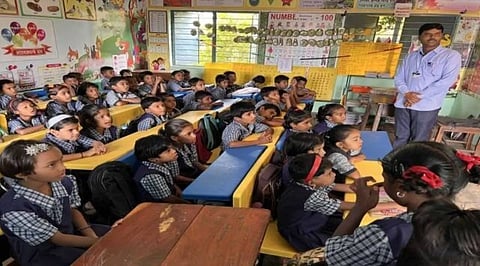


India's education system has undergone significant changes over the past decade, with improvements in school infrastructure, a larger teaching workforce and an expanding higher education sector. However, changing demographics, the movement of enrolment across locations and uneven pathways from education to employment are creating new challenges for the system.
A November 2026 working paper, How India is Transforming Educational Capacity under the New Education Policy 2020: School networks, higher education and pathways to work, by Soumya Kanti Ghosh and Shashidharan Sharma, examines these changes. The paper, published by the Economic Advisory Council for the Prime Minister (EAC-PM), argues that the country's education policy challenge is no longer simply one of expanding the number of schools, colleges or qualifications. It is also about where educational facilities are located, what they offer and whether students can progress from education into further study and employment.
The paper identifies two broad areas requiring attention: the reorganisation of school networks in response to demographic and spatial changes, and the development of credible academic, vocational and work-linked pathways beyond school.
Why is the number of schools declining?
Between 2018-19 and 2025-26, the number of reported schools in India declined from 15.51 lakh to 14.67 lakh, a reduction of 5.4 per cent, according to the paper's analysis of UDISE+ data.
The decline was more pronounced among primary-only schools, which fell from 8.27 lakh to 7.22 lakh, or 12.6 per cent. At the same time, the number of schools offering education up to Class XII increased from 1.30 lakh to 1.69 lakh, a rise of 29.7 per cent.
The paper cautions against interpreting the decline in reported school numbers as a direct count of closures. Changes in school codes can result from mergers, upgrades, management changes, the removal of inactive records or corrections to the database. A primary-only school that adds higher classes, for instance, moves out of that category even if teaching continues on the same campus.
The authors therefore describe the change as a combination of a smaller reported network and an expansion in the grade span of school provision. The available aggregate data do not establish how much of the decline resulted from actual closures.
How are demographic changes affecting school planning?
The paper identifies a shrinking population of children entering primary-school age as one of the factors that should inform future school planning.
India's total fertility rate declined from 2.1 in 2019 to 1.9 in 2024. Population projections based on Census 2011 indicate that the population aged five to nine could decline from 12.53 crore in 2011 to 11.27 crore in 2026 and 10.02 crore in 2036. The projected population for 2036 is about one-fifth smaller than that of 2011.
However, the paper argues that a declining child population does not translate into a uniform fall in demand for schools across the country. Enrolment patterns are also changing across rural and urban locations.
Between 2012-13 and 2021-22, enrolment in schools classified as rural declined from 18.71 crore to 17.93 crore, a fall of about 78 lakh. During the same period, enrolment in urban-located schools increased from 6.72 crore to 7.64 crore, an addition of about 93 lakh. The urban share of enrolment rose from 26.4 per cent to 29.9 per cent.
The paper clarifies that these figures refer to the location of schools, not the migration history of individual students. They cannot establish that migration alone caused the change. They do, however, indicate that lower enrolment in rural locations can coexist with increasing demand for capacity in urban areas.
The authors argue that school planning must therefore consider local population patterns, settlement growth, current enrolment, roads and locally available migration indicators rather than rely on national averages.
Does a smaller school network mean better efficiency?
Not necessarily, according to the working paper. It argues that decisions to reorganise school networks must consider educational access and the costs borne by students and their families.
The National Education Policy (NEP) 2020 recognises that very small schools can face operational constraints. Low enrolment can make it difficult to provide subject teachers, laboratories, libraries, counsellors, sports and arts facilities, as well as support for children with disabilities.
One of the policy's responses is the school complex or cluster model. Under this arrangement, nearby schools and Anganwadis can share teachers, facilities, leadership and professional development while continuing to teach students at more than one location.
The paper distinguishes between sharing institutional resources and physically closing a teaching site. It argues that school complexes can help address resource constraints without necessarily increasing the distance children must travel.
Where consolidation is considered, the authors recommend assessing the quality and capacity of the receiving school, transport arrangements, travel time, safety, disability access and the effect on attendance and progression. These considerations are particularly important for young children, girls, students with disabilities and those in remote or tribal areas.
The paper also recommends that proposed mergers or closures be accompanied by a School Network Impact Statement, community consultation and independent review. It argues that public school sites should be retained in an asset register until an approved plan for their reuse is in place.
Has higher education expansion created enough opportunities?
Higher education enrolment increased from an estimated 3.42 crore in 2014-15 to 4.50 crore in 2023-24, a rise of 31.5 per cent, according to the paper. The number of registered colleges increased from 38,498 to 48,246, while universities and university-level institutions increased from 529 to 1,289.
Female enrolment rose from 1.57 crore to 2.24 crore during this period. Enrolment among Scheduled Caste, Scheduled Tribe and Other Backward Class students also grew faster than overall enrolment.
The paper views this expansion as an increase in educational opportunity, but argues that enrolment and institutional numbers alone do not reveal the quality of programmes or the employment outcomes of graduates.
Its analysis of fixed panels of 17 Indian Institutes of Technology (IITs), 14 Indian Institutes of Management (IIMs) and 22 National Institutes of Technology (NITs) found that core-programme enrolment increased between 2019 and 2025. The share of women also increased across all three groups.
The number of students recorded as placed between 2015-16 and 2023-24 increased from 4,737 to 8,411 at the IITs, 3,776 to 5,965 at the IIMs and 9,246 to 13,419 at the NITs. The paper also recorded increases in the nominal median salaries reported by these institutions.
However, the authors caution that these outcomes relate to selective institutions and do not represent the entire higher education system. They argue that programme quality, employer confidence and labour-market outcomes remain unevenly distributed.
What does the paper mean by 'qualification congestion'?
The working paper uses the term 'qualification congestion' to describe the growing concentration of student aspirations around general degrees.
It traces this pattern to the development of India's common academic structure. The 10+2+3 system, introduced nationally in 1987, established a more comparable sequence of schooling and made higher secondary education a point at which academic and vocational routes could diverge.
However, the paper argues that the academic pathway developed more successfully than the vocational and work-linked alternatives. Academic qualifications offered a clearer route to recognised examinations, college admission and formal employment, while vocational routes remained narrower, less portable and less securely connected to further study.
As higher education expanded, degrees became more common. Employers increasingly differentiated among graduates based on the institution attended, field of study, examination performance, internships, work experience and professional networks.
The paper cites labour-market evidence showing that 57.8% of employed young people with a graduate degree or higher held regular salaried work, while 36.1% were in formal employment. At the same time, 52.8% of employed young graduates were classified in the report's low-skill occupational group in 2022.
These figures, the authors clarify, do not establish individual skill deficits or prove that degrees have lost their value. They indicate that employment outcomes and the returns associated with a degree are uneven.
The limited reach of formal vocational training is another part of this imbalance. According to the paper, only 5% of people aged 15-29 had received formal vocational or technical training in the Periodic Labour Force Survey 2025.
The authors argue that families continue to view degrees as a safer route to social and economic mobility when vocational qualifications offer uncertain progression, limited portability or weaker pay, protection and status.
Can NEP 2020 address the gap between academic and vocational education?
The working paper argues that NEP 2020 seeks to address this imbalance by reducing the separation between academic and vocational education.
The policy envisages practical exposure, internships, recognition of prior learning and the accumulation of credits across institutions and qualifications. The paper argues that these measures can create more flexible pathways, allowing students to move between education and employment rather than being restricted to a single route.
However, it stresses that such pathways must be recognised and portable in practice. Credits should be accepted by other institutions, intermediate qualifications should have labour-market value, workplace learning should be assessed, and students should be able to return to further education after entering employment.
The authors also argue that employers should participate in curriculum design, occupational standards, assessment and workplace training, rather than limiting their involvement to recruiting graduates.
A credible apprenticeship, the paper says, must include structured instruction, supervision, fair compensation, workplace protection and independent assessment. The qualification should remain valuable beyond the training firm and count towards further education.
What does the paper recommend?
The working paper proposes treating school education, higher education and employment pathways as connected parts of the same system.
For school networks, it recommends that districts maintain rolling ten-year demographic forecasts and assess demand at the level of individual catchments. School complexes and shared resources should be considered before relocating students, while any proposed consolidation should account for receiving-school capacity and funded transport.
It also recommends greater transparency in school reorganisation through public impact statements, community consultation, independent review and monitoring of affected students.
For education beyond school, the authors call for portable credits, recognised occupational standards, assessed apprenticeships and opportunities to move between vocational qualifications, diplomas and degrees. They also recommend matching higher education expansion with adequate faculty, laboratories and workshops, and publishing information on staffing, completion and employment outcomes.
The paper's central argument is that India's next education challenge is not simply to expand institutional capacity, but to ensure that it is distributed according to changing demand and translates into meaningful learning and employment opportunities.
The authors conclude that the success of the education system should be assessed by whether students can access education, acquire valued capabilities and move between further study and work without losing time, safety or status.