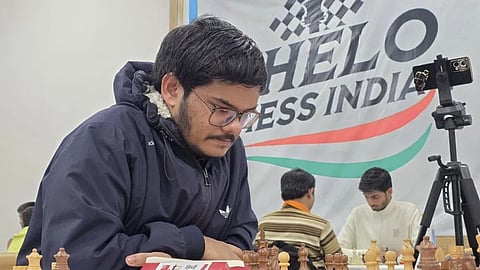


India has reached 100 chess Grandmasters, with 22-year-old Anuj Shrivatri of Madhya Pradesh becoming the latest player to earn the title after winning the seventh ASEAN Plus Individual Open Chess Championship in the Philippines on November 8.
The victory also made Shrivatri the first Grandmaster from Madhya Pradesh. He secured the title through a direct-title provision associated with the tournament, rather than the conventional route of completing three Grandmaster norms and crossing a FIDE rating of 2,500.
The milestone comes 38 years after Viswanathan Anand became India's first Grandmaster in 1988. From one player in the late 1980s to 100 in 2026, India's growth in competitive chess has brought the title within reach of a much larger pool of players.
But what exactly is a Grandmaster? How does a chess player earn the title, and what separates a Grandmaster from other titled players?
What is a Grandmaster?
Grandmaster (GM) is the highest standard open title awarded by the International Chess Federation, known by its French abbreviation FIDE. It is one of the most recognised distinctions in competitive chess and is awarded to players who meet specific performance and rating requirements.
FIDE administers international chess titles through its Qualification Commission. Once confirmed, the Grandmaster title is held for life, subject to FIDE's regulations.
The title is open to both men and women. Women can also earn separate women-only titles, including Woman Grandmaster (WGM), which has different qualification requirements.
A Grandmaster is not necessarily the world's highest-rated player. The title recognises a player's achievement in meeting established standards, while the FIDE rating indicates their playing strength relative to other rated competitors.
How does a player become a Grandmaster?
Under the conventional route, a player must meet two principal requirements:
Reach a FIDE rating of 2,500: A player must achieve a standard chess rating of at least 2,500 at some point in their career. This is an internationally calculated rating based on results against other rated players.
Earn three Grandmaster norms: A norm is a performance-based qualification achieved by meeting specific conditions in an eligible tournament. A player generally needs three GM norms covering at least 27 games.
A norm is not awarded simply for winning a tournament. It depends on the strength and composition of the opposition, the player's score, the tournament format and other FIDE conditions. A player must demonstrate Grandmaster-level performance against a sufficiently strong and internationally diverse field.
The rating and norm requirements are separate. A player may complete all three norms but still need to reach the 2,500 rating threshold before qualifying for the title.
There are also special provisions under which players can earn a direct Grandmaster title through certain recognised tournaments and championship results. These are exceptions to the conventional norm-based route and have their own eligibility conditions.
What are the other titles in chess?
FIDE awards several international titles based on a player's performance and rating. The four principal open titles, arranged from the highest to the lower levels, are:
Grandmaster (GM): The highest standard open title. The conventional qualification route requires a 2,500 rating and three GM norms.
International Master (IM): The title below Grandmaster. It generally requires a 2,400 rating and three IM norms.
FIDE Master (FM): Usually awarded after a player reaches a standard rating of 2,300. Norms are not required.
Candidate Master (CM): Usually awarded after a player reaches a standard rating of 2,200. Norms are not required.
These titles are distinct from national-level titles awarded by individual chess federations. They are recognised internationally by FIDE.
What is the Elo rating system?
The Elo rating system measures a chess player's relative playing strength. It is named after Arpad Elo, a Hungarian-American physics professor who developed the system.
A player's rating changes according to the results of games against other rated opponents. Defeating a highly rated player generally earns more rating points than beating a lower-rated opponent. Losing to a lower-rated player can result in a larger deduction.
The system also considers the expected result based on the difference between the players' ratings. A player who consistently performs better than expected gains rating points over time.
A rating of 2,500 is an important threshold in the conventional Grandmaster qualification process. Players who cross 2,700 are commonly referred to as super Grandmasters, although this is an informal description rather than a separate FIDE title.
Who was India's first Grandmaster?
Viswanathan Anand became India's first Grandmaster in 1988. The Chennai-born chess player was 18 at the time and went on to become one of the most influential figures in Indian and international chess.
Anand won the World Chess Championship five times and became the first Indian to win the title in 2000. His success brought greater visibility to chess in India and encouraged a generation of young players to pursue the sport professionally.
Dibyendu Barua became India's second Grandmaster in 1991, followed by Praveen Thipsay in 1997. The number of Indian Grandmasters grew gradually in the following years before accelerating in the 2010s and 2020s.
The country's recent generation includes D Gukesh, who became the youngest undisputed World Chess Champion in 2024, R Praggnanandhaa, Arjun Erigaisi, Nihal Sarin and R Vaishali.
How has India reached 100 Grandmasters?
India's first 50 Grandmasters took nearly three decades to emerge after Anand's achievement. The pace increased considerably in the following years, with the country adding several new Grandmasters annually.
The final five players who took India from 95 to 100 in 2026 were Ethan Vaz, Harshvardhan GB, S Ashwath, V Rathnavel and Anuj Shrivatri.
Tamil Nadu has played a major role in the country's chess development. 39 of India's 100 Grandmasters are from the state. Chennai, in particular, has developed a strong chess ecosystem, with training academies, tournaments and access to experienced coaches.
The rise in the number of Grandmasters also reflects the expansion of competitive chess beyond a handful of established centres. Players from states such as Assam, Goa, Madhya Pradesh and Telangana have entered the national list, adding to the geographical spread of the sport.
India's 100th Grandmaster marks a significant point in that development. For Shrivatri, it is the culmination of years of preparation and a career decision. For Indian chess, it records how far the country has travelled since Anand earned the title in 1988.