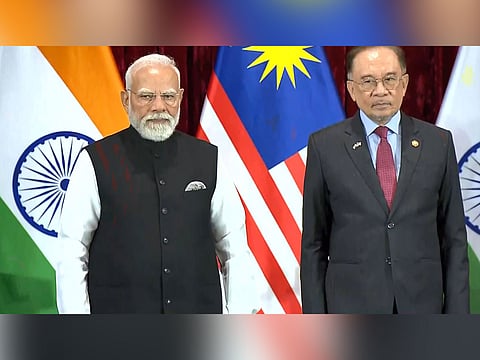

Kuala Lumpur: India and Malaysia on Sunday resolved to infuse fresh momentum into their strategic partnership, significantly broadening defence and security collaboration while pushing forward joint initiatives in high-priority emerging sectors such as semiconductors, artificial intelligence and digital payments.
Prime Minister Narendra Modi described this renewed engagement as bringing "new speed and depth" to bilateral relations during his first foreign visit of 2026.
Speaking at a joint press conference with Malaysian Prime Minister Anwar Ibrahim, PM Modi announced that both countries had committed to advancing their partnership in an exceptional manner, building on the steady expansion of cooperation in energy, infrastructure, manufacturing and technology.
"Inspired by our achievements, today we have decided to bring unprecedented speed and depth to our partnership," Modi said, crediting Anwar Ibrahim for providing new energy to the relationship in recent years.
A central element of the discussions centred on security, with both leaders agreeing to reinforce cooperation in counter-terrorism, intelligence sharing and maritime security to tackle shared concerns in the Indo-Pacific. PM Modi emphasised that defence ties would be expanded to contribute more effectively to regional stability.
"In the field of security, we will strengthen cooperation in counter-terrorism, intelligence sharing and maritime security," he said, adding that defence cooperation would be made "more comprehensive".
Beyond security, the two sides pledged to deepen collaboration in semiconductors, health and food security, alongside continued progress in AI and digital technologies.
PM Modi highlighted the CEO Forum held on the sidelines, which had unlocked promising avenues for trade and investment, and affirmed that the partnership would drive "economic transformation based on strategic trust". ".
This economic push aligns with the consistent growth in bilateral ties in recent years, marked by rising investments in the digital economy, biotechnology and IT, as well as stronger tourism and people-to-people connections.
PM Modi gave special prominence to the role of the nearly three-million-strong Indian diaspora in Malaysia, describing it as a crucial link that strengthens relations.
"This living bridge of three million people is one of our greatest strengths," Modi said, noting that welfare measures for the community provide bilateral ties with a "humane foundation".
To deliver direct benefits to citizens, he pointed to concrete steps, including the Social Security Agreement protecting Indian workers in Malaysia, the introduction of gratis e-visas for tourism, and the deployment of India's UPI digital payment system in Malaysia.
"Any partnership succeeds only when its benefits reach the people directly," he said.
Complementing these practical measures, PM Modi underscored the deep cultural bond between the two nations, particularly their shared love for the Tamil language, which remains vibrant in Malaysia's education, media and cultural domains. He expressed confidence that a new audio-visual agreement would further unite the societies through films and music, especially Tamil cinema.
The leaders also agreed to expand opportunities for youth through university exchanges, startup collaborations and skill development initiatives. To support the growing engagement, PM Modi announced the opening of a new Indian consulate in Malaysia.
On the regional stage, PM Modi reaffirmed India's strong commitment to ASEAN centrality, congratulated Malaysia on its successful ASEAN chairmanship, and confirmed that both sides would expedite the review of the ASEAN-India Trade in Goods Agreement (AITIGA).
"The Indo-Pacific region is emerging as the engine of global growth," Modi said, stressing that India and Malaysia remain dedicated to peace, stability and development across the region.
The talks extended to broader regional and global challenges, including the urgent need to reform international institutions.
"To address today's challenges, reform of global institutions is essential," Modi said, while firmly reiterating India's stance on terrorism: "No double standards. No compromise."
The visit holds added significance as PM Modi's first overseas trip of 2026. He recalled having missed the previous year's ASEAN Summit in Malaysia and his subsequent promise to Anwar Ibrahim to visit at the earliest opportunity.
PM Modi praised Anwar Ibrahim's steadfast commitment to the relationship and voiced optimism that the two nations could jointly realise the vision of a "prosperous Malaysia" and a "developed India".
"Let us work together to realise your dream of a prosperous Malaysia and our resolve for a developed India," he said, while extending an invitation to the Malaysian Prime Minister to visit India.
The day began with delegation-level talks focused on strengthening defence and security cooperation and expanding economic and innovation partnerships, during which several agreements were signed, including in the semiconductor sector.
India and Malaysia had upgraded their bilateral relationship to a Comprehensive Strategic Partnership in August 2024.

