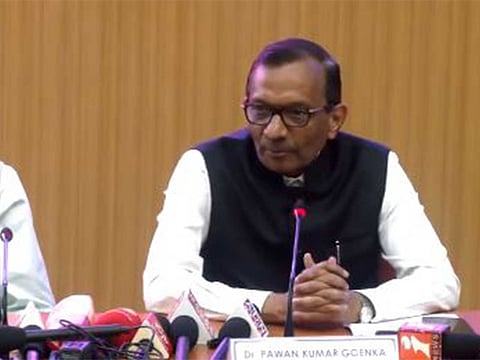

Sriharikota (Andhra Pradesh) [India], July 18 (ANI): IN-SPACe Chairman Pawan K Goenka on Saturday said there was a minor issue during the initial automatic launch sequence of Skyroot Aerospace's Vikram-1, India's first privately developed orbital-class rocket, but it was quickly resolved, and the mission proceeded smoothly.
During a press conference, he said, "There was a small hiccup in the beginning in the automatic launch sequence, but it was a very minor thing. It was quickly rectified and restarted, and after that we had an absolutely smooth sail."
Goenka lauded the hard work which led to the success in the first attempt. "The team has worked extremely hard for many years to get to this point and succeed in the very first attempt," he added.
He congratulated the Skyroot Aerospace team for successfully achieving the milestone, highlighting the efforts behind the development of the private-sector rocket.
Skyroot Aerospace CEO and Founder Pawan Kumar Chandana said the mission was a historic moment as it marked the first time an Indian private company had built an orbital-class rocket, developed the launch infrastructure, and successfully carried out an orbital mission.
"This is the first time that a private company in India has built the rocket, brought the launch pad, and taken off. It is a very important moment for the global space sector. We are proud that we were able to do this. A team with an average age of just 28 years has built India's first private orbital rocket. The rocket is completely built with carbon composite," Chandan said.
Skyroot Aerospace COO and Co-founder Naga Bharath Daka described the achievement as a significant milestone, saying India had become the third country with private orbital launch capability.
"This is a significant milestone," Daka said.
Indian Space Research Organisation (ISRO) Chairman V Narayanan congratulated Skyroot Aerospace and said the successful mission demonstrated the growth of India's private space ecosystem.
"Today's achievement is great for the Indian space sector, and we have to thank Prime Minister Narendra Modi for his visionary leadership. A startup company, Skyroot Aerospace Systems, which started just eight years back, developed an orbital launcher and made a successful mission in the first attempt," Narayanan said.
Explaining the initial issue during the launch sequence, Narayanan said there was a brief technical glitch during the automatic sequence transition from the ground segment to the onboard computer, which was resolved before the launch
"When the automatic sequence was running, there was a smooth transfer from the ground segment to the onboard computer, but that did not take place because of a glitch. We had to resolve the problem and come back. We could immediately return in 35 minutes and have the launch," he said.
Skyroot Aerospace's Vikram-1 Test Flight-1 has successfully reached orbit, marking the maiden flight of India's first privately developed orbital-class rocket.
The rocket completed its final burn and injected its payloads into a nearly 450-km orbit, making India the third country in the world with private orbital launch capability.
The mission, named "Mission Aagaman", was executed from the Satish Dhawan Space Centre. The 24-metre carbon-composite rocket completed all planned flight stages, including stage separations and the firing of its Orbital Adjustment Module (OAM).
The Orbital Adjustment Module fired its 3D-printed liquid engine for the final push to orbit. The module is designed to start, stop and restart in space.
During the flight--Kalam-1200, the solid first stage carried the rocket through the thickest part of the atmosphere before separating cleanly. The payload fairing was then separated, exposing the satellites to space for the first time.
The second stage, Kalam-250, completed its burn and separated, followed by the ignition of Kalam-100, the smallest and highest-flying solid stage of Vikram-1.
The solid-propulsion phase concluded with the separation of Stage 3, paving the way for the Orbital Adjustment Module to complete the mission.
The Vikram-1 rocket, powered by three solid-fuel stages and a liquid orbital adjustment module, is designed to deploy payloads up to 350 kg into a 450-km Low Earth Orbit (LEO).
The maiden flight carried multiple payloads, including the "Diamond Lotus", a lab-grown diamond from Bengaluru-based Cosmos Diamonds.
Among the payloads on Vikram-1 Test Flight-1 is something truly special--a handwritten postcard from PM Modi with the words, "Vande Mataram". It travels to space alongside handwritten messages from the Skyroot team, investors, policymakers, and well-wishers across the globe, making Mission Aagaman a celebration carried by many hands and shared by millions.
—
This report was published from a syndicated wire feed. Apart from the headline, the EdexLive Desk has not edited the copy.

