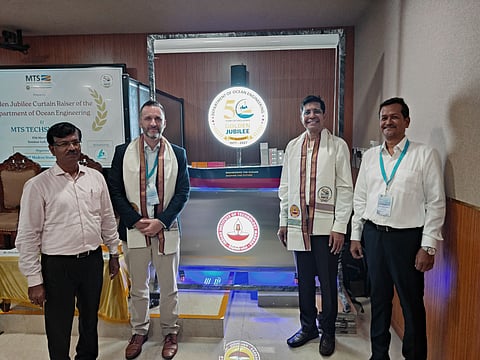

The Indian Institute of Technology Madras’ Department of Ocean Engineering has entered its Golden Jubilee year, marking five decades of contributions to ocean science, maritime engineering and national maritime infrastructure development.
Among the IITs, only IIT Madras and IIT Kharagpur offer specialised undergraduate programmes in this field.
As India strengthens its focus on the Blue Economy, deep ocean mission, shipbuilding and green port development, the Department aims to play a key role in advancing research, education and technology development related to ocean resources and maritime infrastructure.
The Department plans to expand research activities in offshore renewable energy, including wave energy and other ocean-based energy systems, while developing technologies to improve coastal resilience and climate change adaptation. It is also integrating AI and Data Science into its academic programmes and research.
Addressing the Golden Jubilee celebrations launch event on the campus on Tuesday, Prof. V. Kamakoti, Director, IIT Madras, said the Department of Ocean Engineering has been doing yeomen service to the nation, with several projects of national importance successfully delivered to multiple organisations. He added that the Department has developed several Aatma Nirbhar platforms for different stakeholders in the maritime area, significantly reducing dependence on foreign nations.
Established in 1977 as the Centre of Ocean Engineering and later becoming a full-fledged department in 1982, it has grown into one of India’s leading academic centres for research and development and education in ocean engineering, naval architecture and offshore technology.
Over the past five decades, the Department has played a significant role in addressing real-world challenges in coastal protection, marine infrastructure and ocean technology. Its expertise has contributed to several national projects, including coastal protection initiatives, port development studies, dredging assessments and marine hydrodynamics research along India’s coastline.
Speaking on the occasion, Prof. Abdus Samad, Head of the Department of Ocean Engineering, IIT Madras, said that as India works toward ‘Viksit Bharat 2047’, the Department is committed to strengthening research, education and innovation in maritime technologies while supporting the nation’s growing Blue Economy and sustainable ocean development.
Prof. S.A. Sannasiraj, organising chair for the Golden Jubilee events and faculty member of the Department, said the Department continues to strive for excellence across all domains of ocean engineering, from inland waterways to the coast, and from shallow to deep waters.
The Golden Jubilee celebrations will include year-long academic events, international conferences, industry interactions and alumni engagement programmes. Upcoming events include the International Workshop on Offshore Oil and Gas 2026, PIANC-COPEDEC XI – The Eleventh International Conference on Coastal and Port Engineering in Developing Countries, and the International Conference on Fluid Mechanics and Fluid Power.
The Department has 26 faculty members and a strong portfolio of sponsored research and consultancy projects supported by ministries of Earth Sciences, New and Renewable Energy, Ports, Shipping and Waterways, Education and the Department of Science and Technology.
Among its notable contributions are scientific and engineering support for the restoration and protection of Vaan Island in the Gulf of Mannar, and research inputs for environmental studies in Chilika Lake, Odisha, supporting restoration planning and ecological improvements that contributed to increased fish catch and a rise in Irrawaddy dolphin populations.
Researchers from IIT Madras also contributed to the design of an artificial sea mouth at Chilika Lake, improving tidal exchange and ecological health, which helped the wetland be removed from the Ramsar Montreux Record of threatened sites. The Department has also supported shoreline protection projects such as the artificial reef system in Puducherry aimed at mitigating coastal erosion.
Its expertise has extended to infrastructure and water management initiatives, including the design of a check dam with a subsurface dyke across the Palar River to conserve rainwater and prevent seawater intrusion into groundwater aquifers.
The Department has collaborated with national agencies, including the Indian Navy, on ocean technology, naval architecture and marine structures. A recent memorandum of understanding further strengthens cooperation in research, maritime technology and strategic applications. Its facilities have also supported design and testing activities related to space re-entry modules developed by the Indian Space Research Organisation.
The Department contributed to the commissioning of the Vizhinjam International Seaport, where IIT Madras served as the Independent Engineering Division and issued the certificate declaring the port fit for commercial commissioning following successful trial runs. Internationally, it has participated in collaborative research on offshore aquaculture safety involving institutions from the United Kingdom, Greece, Norway, China and Ireland.
The Department hosts advanced experimental facilities, including one of Asia’s largest wave basins for studying ocean waves and offshore structures, and a 360-degree ship navigation and manoeuvring simulator used for maritime operations and port studies. Additional laboratories include wave basins, wave flumes, wave–current flumes and towing tank facilities supporting research in ships, offshore structures, coastal engineering and marine renewable energy.
These facilities, developed with technical assistance from the German Federal Government and supported by funding of about ₹100 crore from the Ministry of Ports, Shipping and Waterways, are being expanded with a new long towing tank facility to strengthen research in ship hydrodynamics and offshore engineering.
The Department is currently home to around 600 students across undergraduate, postgraduate and doctoral programmes. It offers a B.Tech in Naval Architecture and Ocean Engineering and M.Tech programmes in Offshore Structures, Ocean Technology and Petroleum Engineering, and has recently started postgraduate and doctoral programmes in Petroleum Engineering. The petroleum engineering programme at IIT Madras is ranked 31st in the world according to QS.

