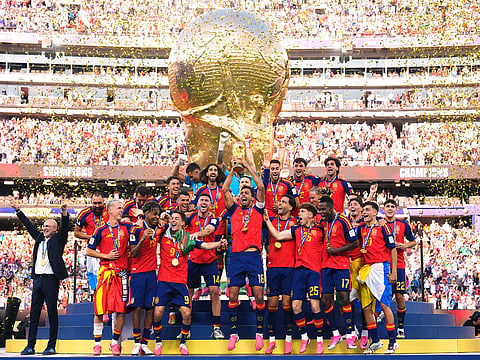

The 2026 FIFA World Cup drew to a close with Spain lifting the trophy after a hard-fought final against Argentina, bringing down the curtain on a month of late-night watch parties and early-morning debriefs for millions of football fans, especially the younger ones.
Across the world, children and teenagers have been recreating spectacular goals in parks and school grounds, and arguing over their favourite players. While much of the conversation so far has centred on the tournament's defining moments and eventual champions, the World Cup also presents an opportunity to ask a different question, one that education and child development researchers have spent decades trying to answer: why do games and team sports occupy such an important place in childhood? What keeps drawing children back to the playground? At what point does a game become something more than a game?
These questions are particularly relevant at a time when young people are watching more sport than ever, while playing less. According to the World Health Organization (WHO), around 81% of adolescents aged 11 to 17 worldwide do not achieve the recommended 60 minutes of daily physical activity, with girls less active than boys in almost every region. Public health researchers now describe physical inactivity as one of the defining health challenges facing young people, not only because of its long-term effects on physical health, but because it also shapes how children learn, socialise and develop.
Developmental psychologists have long argued that play is more than simple recreation; it is, in fact, one of the primary ways children understand the world. Organisations including the American Academy of Pediatrics describe it as essential to healthy childhood development. Through games, children negotiate rules, resolve disagreements, test boundaries, manage setbacks, and discover what they are capable of. Free play also gives children something all humans crave on an instinctive level: autonomy. Unlike heavily adult-directed environments, it allows them to make decisions, solve problems, and experience consequences on their own.
Researchers describe team games as environments where learning happens continuously, even when nobody is consciously teaching. Football, cricket, basketball and other open-skill sports require players to adapt to changing situations, anticipate teammates' and opponents' actions, communicate under pressure and make rapid decisions. A growing body of neuroscience and sports psychology research suggests that such activities strengthen executive functions such as attention, cognitive flexibility, planning and self-control, the very mental processes that underpin learning in classrooms. Systematic reviews published in journals including the British Journal of Sports Medicine have found that regular physical activity is associated with improvements in executive functioning and, in particular, mathematics performance.
Then there is the social dimension. Reviews published in journals such as JAMA Pediatrics and Sports Medicine consistently report that children and adolescents who participate in team sports tend to experience lower levels of anxiety, depression and loneliness than those who are inactive. Researchers argue that these benefits arise from the innate sense of belonging that a sports environment creates. Teams provide friendship, shared purpose, identity and mutual responsibility, all of which are recognised as important protective factors for adolescent wellbeing.
That may also help explain football's extraordinary reach. Unlike many organised sports, football demands remarkably little: a ball, an open space, and a few willing participants are often more than enough. Long before stadiums and trophies, one can imagine the children of our ancestors discovering, almost instinctively, the joy of simply kicking something towards a friend. Whether or not it is the oldest “game” humans have played, it surely feels like one of the most elemental. It is this simplicity, more than anything else, that may have carried football across cultures, languages, and generations, making it perhaps the world's most universal language of play. The FIFA World Cup, then, is simply its grandest expression.
Ironically, this celebration of sport arrives at a time when opportunities for everyday play are becoming scarcer. Reports from the WHO, UNICEF and child development researchers point to a convergence of pressures: increasing urbanisation, shrinking access to safe outdoor spaces, greater academic demands, rising recreational screen time, and so on. The list seems almost unending. Together, these forces leave many children with fewer opportunities for the kind of spontaneous, self-directed play that earlier generations often took for granted. The result is a striking paradox where elite sport has never been more visible or more celebrated, yet many of the conditions that allow children to develop a lifelong relationship with play are steadily disappearing.
While modern schools are already prioritising the incorporation of sport into students' routines, its educational value extends beyond merely keeping children physically active. The deeper lesson lies in understanding why games engage young people so effectively. Team sports provide immediate feedback, visible progress, shared goals, meaningful collaboration and space to fail without lasting consequences. These are also many of the conditions under which meaningful learning flourishes.

