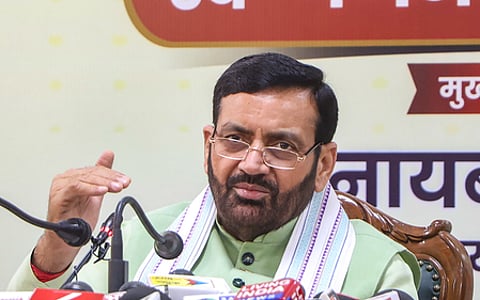
GURUGRAM: Haryana Chief Minister Nayab Singh Saini on Monday launched the state's flagship 'Make in Haryana Industrial Policy 2026', setting an ambitious target of attracting Rs 5 lakh crore in fresh investments and generating 10 lakh jobs over the next five years. The launch was accompanied by the signing of Memorandums of Understanding (MoUs) worth Rs 1.10 lakh crore and the unveiling of nine sector-specific industrial policies.
The policy, which replaces the Haryana Enterprises and Employment Policy (HEEP) 2020, is designed to position Haryana as a leading investment destination and a hub for future-ready manufacturing, exports, and innovation.
Addressing industry leaders and investors in Gurugram, Saini said the state aims to create a business-friendly ecosystem that accelerates industrial growth while expanding employment opportunities. The policy targets ₹5 lakh crore in new investments, 10 lakh jobs, and a significant increase in exports over the next five years.
A key feature of the new framework is the replacement of Haryana's earlier A, B, C, and D block classification system with a simplified area-based model categorising regions as Core, Intermediate, Sub-Prime, and Prime/Focus Areas. The government says the change will make incentives more transparent and encourage balanced industrial development across the state.
Alongside the flagship industrial policy, the government unveiled nine sector-specific policies covering emerging and high-growth sectors such as artificial intelligence, electronics manufacturing, data centres, pharmaceuticals, agro-processing, animation and gaming, Global Capability Centres (GCCs), and green industries.
The state also launched an Intelligent Investment Facilitation Portal aimed at streamlining approvals and improving the ease of doing business. Officials said the platform is expected to reduce procedural delays and offer investors a single-window interface for clearances and regulatory services.
The industrial push comes as Haryana seeks to strengthen its position in advanced manufacturing and emerging technologies. Recent government initiatives have focused on electric vehicles, semiconductors, artificial intelligence, logistics, and electronics manufacturing, with Gurugram and the NCR region emerging as key investment hubs.
The policy also significantly enhances employment-linked incentives. According to details approved by the state cabinet earlier, employment generation subsidies have been increased, with eligible industries able to receive up to ₹1 lakh per employee per year for a period of 10 years under certain categories.
The policy forms part of Haryana's broader economic vision, which includes transforming the state into a major manufacturing and innovation centre while supporting long-term goals of employment generation, export growth, and industrial competitiveness.

