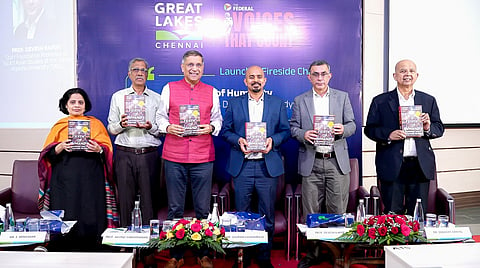

Great Lakes Institute of Management, Chennai hosted the official launch of A Sixth of Humanity, authored by former Chief Economic Advisor of India Arvind Subramanian and Johns Hopkins University (SAIS) professor Devesh Kapur.
The book examines India’s development trajectory through structural themes and long-term trends that have shaped the country’s political, economic and social landscape.
A Sixth of Humanity traces India’s evolution through five interconnected themes: the forging of a diverse nation, the advancement of democracy ahead of prosperity, the uneven capacity of the state in delivering public goods, the expansion of markets without consistent structural transformation, and society’s navigation of identity and change.
Drawing on data, institutional research and historical context, the authors present a long-view analysis of India’s achievements, constraints and future possibilities.
Faculty, students and invited guests participated in conversations exploring the book’s central ideas, supporting evidence and their relevance to India’s future.
The launch included a fireside discussion featuring the authors and Prof. Vidya Mahambare, Professor of Economics at Great Lakes Institute of Management.
Welcoming the authors, Dr Debashis Sanyal, Director of Great Lakes Institute of Management, said that management education extends beyond technical skills, noting that students must understand the larger political, economic and social systems influencing decision-making in India. He said the book encourages the kind of contextual thinking the institution values.
Gautam Lakhamraju, Chief Operating Officer of Great Lakes Institute of Management, remarked that India is often seen through headlines, while the real story lies in the systems beneath. Understanding those systems, he said, is as important for managers as mastering financial models or frameworks.
The event concluded with an interactive question-and-answer session, where students and faculty engaged the authors on themes including state capacity, employment, demographic transitions and market evolution.

