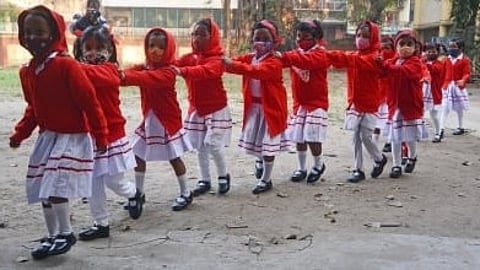


The Goa government is preparing to revise its foundational education strategies based on the results of an assessment conducted among around 40,000 students in Classes 1 and 2 across government and government-aided schools.
The Goa State Council for Educational Research and Training (GSCERT) conducted the assessment in October to examine whether students had acquired age-appropriate competencies in the early years of schooling. The results will be analysed to evaluate the implementation of the National Education Policy (NEP) 2020 and identify areas where students and teachers require additional support.
GSCERT Director Meghana Shetgaonkar said the assessment would provide a baseline for the foundational stage, which extends from Balvatika I, the preschool entry level, to Class 2.
“Now that NEP has been implemented in all grades from Balvatika I to Class VIII, we needed a baseline assessment of the foundational stage, which is from Balvatika I, when the child enters preschool, to Class II. The basics of students need to be strengthened at this foundational stage; it is the basis of the entire NEP implementation. We need to make it strong. Once we analyse the results, we will know what strategy to draw up for these classes if a change in strategy is needed,” Shetgaonkar said.
The findings will also inform the design of training programmes for Balvatika teachers. The State is working to streamline teaching and learning in preschools, many of which are privately operated.
“Already, along with Goa Samagra Shiksha Abhiyan, programmes like NIPUN Bharat Mission to ensure proficiency in reading with understanding and numeracy are being implemented, along with Jaadui Pitara, which includes a play-based learning-teaching material collection developed by the NCERT. We need to see what additional support is required by teachers and students from us,” Shetgaonkar said.
The assessment differs from the common examinations conducted for Classes 3 to 8. While GSCERT provides common question papers for these grades, the assessment for Classes 1 and 2 was designed to examine whether young learners had attained foundational competencies appropriate to their age.
The state-level exercise also covers a larger group of students than the national sample-based assessments, which are conducted periodically for selected grades, including Classes 3, 6 and 8, and involve selected schools.
Goa plans to conduct the foundational learning assessment twice during each academic year, in October and March-April, to monitor students' progress and identify learning gaps at an early stage. The Goa Foundational Learning Survey is aligned with NEP 2020, the National Curriculum Framework for the Foundational Stage and the Centre's NIPUN Bharat Mission.
NIPUN Bharat, launched by the Ministry of Education in 2021, aims to ensure that every child achieves foundational literacy and numeracy by the end of Class 3. Its focus includes reading with understanding, writing and basic mathematical skills.
The state has also introduced play-based learning resources through NCERT's Jaadui Pitara initiative. The learning kit uses toys, games, puzzles, puppets and other activity-based materials to support learning among children in the foundational stage.
The assessment results are expected to help GSCERT determine whether existing programmes are meeting students' learning needs and what further interventions are required across schools.