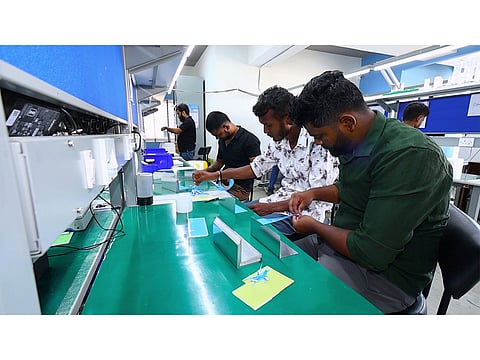

Bengaluru: A student-built drone takes flight, a compact rover rolls into action, and an AI-powered coding tool brings an entire development workflow into one browser. At Bengaluru’s Newton School of Technology, students are turning classroom learning into hands-on innovation.
Meanwhile, local startup Dreamfly Innovations is tackling another challenge for emerging technologies: developing customised batteries for drones and electric aviation.
At Newton School of Technology, students are building a quadcopter drone equipped with a flight controller and a companion computer. While the flight controller manages flight, the companion computer processes camera images to help determine the drone’s position and movement.
“We are building a quadcopter drone that uses a flight controller and a companion computer. The flight controller controls the drone, while the companion computer processes images captured by the camera to determine the drone’s coordinates and estimate the distance it has travelled,” said Aksh Wagale, a student at the institution.

Students are also developing a small rover, assembling its motors, wheels, electronics and software, while experimenting with AI-assisted coding tools that integrate files, terminals and developer tools into a single browser-based environment.
The aim is to give AI agents access to more project context while reducing the need to switch between platforms.
“We brought our coding tools into the browser, integrating terminals, developer tools, code and files in one place. This gives the AI agent a richer understanding of the project and allows developers to manage their entire workflow through a single interface,” said Daksh, a student at the institution.
The emphasis is on building first and learning through experimentation. Students work on projects, troubleshoot problems and then connect practical experience with theoretical concepts.
“If students follow this philosophy, they will start building while they are still studying rather than waiting until graduation or even a PhD. Once someone develops the habit of building things, they are unlikely to give it up,” said Tanmay Pandya, Director of Business at Newton School of Technology.
As drones and other advanced systems evolve, battery performance remains a critical factor in their operation. Bengaluru-based Dreamfly Innovations is developing customised battery packs using lithium-ion and graphene-based technologies for drones and electric aviation applications.
The company focuses on matching battery specifications to the requirements of individual vehicles and missions, rather than relying on standard solutions that may not meet every operational need.
“When we started working in this direction, we realised that batteries for vehicles, drones and aerospace applications were still largely coming from outside India. We had to accept the specifications provided by suppliers, fit the available battery into our vehicle and operate within its limitations,” said Kajal Shah, co-founder and CEO of Dreamfly Innovations.
The company develops battery packs incorporating a Battery Management System (BMS), which monitors temperature, voltage and current to help manage performance and safety.
Battery requirements vary according to a drone’s weight, power consumption and intended use. Agricultural drones may need around 15–20 minutes of flight time, while inspection and surveillance drones may require up to 60 minutes.
“Every drone has specific weight and power consumption requirements. An agricultural drone may need 15 to 20 minutes of flight time, whereas an inspection or surveillance drone may require up to 60 minutes. We research different cells and suppliers to identify suitable options for our customers,” said Dr Saurabh Markandeya, co-founder and CTO of Dreamfly Innovations.
From student-built machines to specialised battery systems, these initiatives reflect two sides of India’s evolving technology ecosystem: developing practical skills among young innovators and building indigenous solutions for emerging industries.
The larger ambition is to move beyond learning about future technologies and start creating them from the classroom to the factory floor and the skies above.
This report was published from a syndicated wire feed. Apart from the headline, the EdexLive Desk has not edited the copy.
