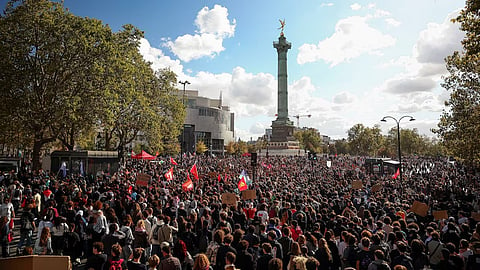


Rats in school corridors, classrooms without enough chairs, lessons cancelled because teachers are absent, and a university admissions system students say leaves their futures uncertain. These are among the complaints driving France's nationwide student protests, which began in September and have escalated into a dispute over the funding and functioning of public education.
At least 141 high schools were reported closed on October 9, as demonstrations continued for a fifth consecutive day in the latest wave of protests. The movement began at a high school in Créteil, southeast of Paris, before spreading to schools and universities across France. On October 6, the Interior Ministry counted 266,000 demonstrators nationwide, while student organisers put the figure at 450,000.
The protests have brought students, teachers, parents and education unions onto the streets. Demonstrators have blocked school entrances, organised marches and demanded changes to staffing, infrastructure and access to higher education. Clashes with police, arrests and serious injuries have added to the pressure on the government.
On October 5, student organisations published a joint platform outlining ten emergency measures. The proposals range from renovating school buildings and recruiting teachers to reforming university admissions, increasing student financial assistance and ending police violence against protesters.
Prime Minister Sébastien Lecornu has promised a government response by the end of October. But students have questioned whether the announcements so far address the scale of their demands.
How did the protests begin?
The movement began on September 21 at a high school in Créteil, in the Paris suburbs, following protests over teaching vacancies and inadequate school resources. Within days, demonstrations spread across the Île-de-France region and then to other parts of the country.
The movement developed without being triggered by a single new education reform. Instead, students brought together complaints about everyday school life, including unfilled teaching positions, overcrowded classrooms, deteriorating buildings and long school days.
Social media helped spread calls for school blockades and demonstrations. By early October, students in cities including Paris, Lyon, Marseille, Lille, Rennes and Nantes were taking part. University students and education unions subsequently joined the mobilisation.
The scale of the demonstrations grew on October 6, when the Interior Ministry reported 266,000 participants nationwide. Student organisers estimated attendance at 450,000. The figures differ because they come from separate estimates, but both indicate that the movement had expanded well beyond its original location.
The protests have also attracted students from different social backgrounds. Pupils from disadvantaged suburbs have described shortages and poor facilities at their schools, while students from more privileged institutions have joined demonstrations in support of better public education.
What are the 10 demands?
The demands, titled The Youth's Demands: Ten Emergency Measures, was published on October 5 by student organisations representing high school and university students. It seeks changes across the education system, including improvements to school facilities, staffing, admissions and student welfare.
The organisations have estimated that their ten-point programme would require €10 billion. They want the proposals considered as part of the government's 2027 budget.
1. Renovate schools and universities
Students want an emergency programme to repair deteriorating and unsanitary school and university buildings. Their demands include functional toilets, adequate maintenance staff and facilities that can cope with heatwaves and cold weather.
Students have reported water leaks, damaged walls, inadequate furniture and rodent infestations in school buildings. They say these conditions make it difficult to learn and highlight the need for greater investment in maintaining public schools.
The demand also includes measures to adapt buildings to climate change, including appropriate cooling, insulation and heating.
2. Recruit more teachers and support staff
The organisations want large-scale recruitment of teachers, healthcare professionals, support staff and careers advisers. Their proposals include a nurse and a psychologist for every 500 pupils.
Teacher shortages have been a central grievance since the movement began. According to figures reported by Reuters, French public secondary schools were unable to staff nearly 10 per cent of teaching hours during the 2024-25 academic year. Around three-quarters of those missed hours resulted from absent teachers not being replaced.
The student organisations argue that recruitment must address the wider needs of schools, rather than focus exclusively on filling teaching vacancies.
3. Reform university admissions
Students have called for the abolition of selection through Parcoursup, France's online platform for applications to higher education. The platform manages applications and admissions decisions for undergraduate programmes.
Students have criticised the uncertainty surrounding admissions and the influence of selection criteria on their future options. Some describe the system as a lottery because applicants can face uncertainty over whether they will secure a place in their preferred course.
The organisations' propose, the baccalauréat, France's secondary school leaving qualification, to guarantee access to a bachelor's degree, and a bachelor's degree to guarantee access to a master's programme.
The proposal would require universities to expand capacity and provide enough places and resources to accommodate more students.
4. Increase student financial assistance
The student organisations have called for monthly student grants to increase by €200 and for payments to continue throughout the year. They have also proposed extending eligibility to an additional 300,000 students.
In the longer term, the organisations want a student independence allowance of €1,337 a month to help cover the cost of studying and living independently.
The proposed increase would provide students with more financial support for living and studying, including expenses such as rent, food and transport.
5. Give students a greater role in school decisions
Students want changes to the way representatives are elected to school councils and other educational bodies. Students want changes to election rules to give student organisations fairer representation and increase the number of student representatives on school boards.
The proposal is intended to give students a formal role in decisions affecting their education, rather than limiting their participation to consultations or protests.
The proposal would give students a greater role in school management and decisions on education policy.
6. Improve housing support
The organisations want housing assistance restored and expanded, including support for international students. They oppose proposed changes that they say could leave 147,000 students without housing benefits.
They have also called for changes to the calculation of housing assistance and for measures to make accommodation more affordable.
Housing costs can determine whether students can move to another city for higher education, remain enrolled or afford basic living expenses. The platform treats accommodation as part of access to education rather than a separate welfare issue.
7. Guarantee affordable university meals
Student organisations want €1 meals to be available to all students and have called for more funding for university catering services. They say affordable meals are essential to ensure that financial difficulties do not prevent students from eating adequately while studying.
8. End differentiated fees for international students
The students want the government to repeal the Bienvenue en France scheme, which introduced higher tuition fees for some non-European international students. They have also called for the abolition of the Student and Campus Life Contribution (CVEC). Arguing that higher fees place additional financial burdens on international students and limit access to higher education.
The proposals extend the protests beyond school-level concerns to university tuition fees and the cost of studying in France.
9. Make student accommodation more affordable
Students want a freeze on rents in CROUS student residences, the public network responsible for university accommodation and food services. They have also called for the renovation of substandard residences and the construction of 15,000 additional CROUS housing units from 2027.
They want public student accommodation to be available to 10 per cent of the student population.
The proposals include measures to increase the availability of affordable housing for students studying away from home, alongside efforts to limit rent increases in public residences.
10. End police violence and repression against student movements
The final demand calls for an end to police action against student protesters. It also calls for officers found guilty of violence to face prosecution and for students not to be penalised for absences related to demonstrations.
The demand follows clashes between students and police during school blockades and street marches. Students have criticised the use of tear gas, batons and other crowd-control measures, while police have cited violence and property damage at some demonstrations.
Students say they should be able to participate in protests without facing disproportionate penalties.
Why are these demands emerging now?
The immediate complaints concern the conditions students encounter in schools. The wider issue is about the ability of France's public education system to provide adequate teaching, facilities and opportunities across different communities.
Reuters reported on October 9 that nearly 10 per cent of teaching hours in public secondary schools went unstaffed in 2024-25. A 2025 report by Banque des Territoires found that between 10 and 20 per cent of French school buildings were in significantly deteriorated condition.
Class sizes are another concern. According to figures reported, public secondary education has fewer teachers than it did in 2008, despite serving 250,000 more students. More than 70 per cent of classes in public general and technical high schools have over 30 pupils, while 20 per cent have more than 35.
These figures help explain why the protests have brought together demands that might otherwise appear separate. Students are questioning whether schools have enough staff and space to provide consistent instruction, while also raising concerns about admissions, financial support and access to higher education.
The movement has also emerged amid pressure on public finances. France is attempting to reduce its budget deficit while meeting demands for additional spending on public services. The dispute is therefore not only about whether the government recognises the problems, but also about whether it will commit sufficient resources to address them.
How has the government responded?
The government has promised to address the students' grievances, but the measures announced so far have not satisfied the organisations leading the movement.
Prime Minister Sébastien Lecornu has said the government will respond to the demands by the end of October. Education Minister Édouard Geffray has announced plans to deploy 3,000 substitute teachers to schools facing acute shortages and to recruit several hundred additional teachers.
The government has also opened a platform for students to submit their concerns. Ministers have indicated that the proposals will be considered in discussions over the 2027 budget.
However, student organisations say consultations and recruitment announcements do not address the full ten-point programme. Their demands include long-term building renovations, a substantial increase in student assistance, changes to university admissions and reforms to student housing.
The cost of implementing these proposals is also a key issue. The student organisations have estimated that their programme would require €10 billion, while the government is under pressure to reduce public borrowing and control expenditure.
The government has also defended its handling of the protests against criticism of police conduct. Following a serious injury to a teenager involving a stun grenade, authorities suspended the use of stun grenades during the demonstrations. Police have said they are responding to incidents of violence and property damage, while students have accused officers of using excessive force.
What happens next?
Student organisations have vowed to continue demonstrations unless the government makes concrete commitments. Education unions have called for another national day of action on October 13.
