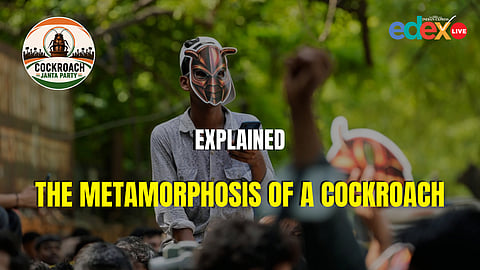


For those who live chronically online, the rise of the Cockroach Janata Party (CJP) needs little contextualising – it fits neatly into the recent wave of memetic political expression where digital satire precedes the manifesto, and the joke is the point until it isn't. For everyone else, the CJP can be diagnostic: a case study in how a single remark, weaponised by a generation fluent in satire, can metastasise into a movement that commands national attention.
The remark that started it
On 15 May 2026, Chief Justice of India Surya Kant was presiding over a contempt petition regarding fraudulent degrees for entering the legal profession, when he said something that escaped the courtroom. Reprimanding a lawyer for what he called frivolous litigation and social media-driven attacks on the judiciary, the Chief Justice drew a parallel that landed badly:
The CJI later issued a clarification, that he had been speaking specifically about individuals who had “infiltrated” law, media, and other professions using forged degrees, and that he held India's youth in high regard. The clarification changed nothing. The remark had already found its audience, the word cockroach was already out, and an internet primed for exactly this kind of provocation had already decided what to do with it.
Subhajit Naskar, Assistant Professor of Political Science at Jadavpur University, views the CJP as less an aberration and more a revelation: a symptom of deeper structural frustrations among young Indians. "The churning among the youth is not only political," he says. "Beneath this political churning lies a social churning around questions of representation, minority protection, social justice, inclusion, job market discrimination, casteism, classism, and elitism. The Chief Justice calling youth cockroaches and parasites only organised all of these into a single momentum."
The cockroach goes public
As the "cockroach" remark ricocheted across social media, Abhijeet Dipke, a 30-year-old political communications professional and former Aam Aadmi Party digital strategist studying public relations at Boston University, posted on X: "What if all cockroaches come together?" Within hours, he had a website. Within a day, he had a party.
The Cockroach Janata Party announced itself as a platform for "the lazy, the unemployed, and the chronically online," with the tagline: Voice of the Lazy & Unemployed. Its stated ideology is Secular, Socialist, Democratic, and Lazy, the last word doing the heaviest satirical lifting by placing self-deprecation alongside the language of constitution. The name itself is a one-letter swap away from the ruling Bharatiya Janata Party (BJP), a joke whose specificity is its entire argument.
Beyond the humor, what makes the CJP interesting is the mechanism. Reclaiming a slur, turning the terms of your own denigration into the banner of a movement, has a long history. The Tories, the Quakers, the Suffragettes, the global queer rights movement – in each case, the insult outlasted the contempt it was meant to express. Whether the cockroach follows that arc remains to be seen. But Dipke understood the principle instinctively: "Those in power think citizens are cockroaches and parasites," he told Al Jazeera from Chicago, days after the launch. "They should know that cockroaches breed in rotten places. That's what India is today."
"The language of the Cockroach Janata Party and of Dipke is, in many ways, the language of Dr BR Ambedkar," says Professor Naskar. "Dipke emerging from Delhi airport waving a copy of Ambedkar's biography was significant because it revived a fading vision of India, an egalitarian India that Dr Ambedkar once imagined. What we are seeing is the re-emergence of that vision in a new political language, and it has found deep resonance among the youth of the country."
The swarm
What followed was difficult to explain by the usual rules of Indian political mobilisation. Within 78 hours, the CJP's Instagram account had crossed three million followers. Within five days, it had surpassed ten million, overtaking the BJP's official handle – a party that has been in operation for over four decades. Within a week, the count crossed twenty million. Over 350,000 people registered as members through a Google form. The hashtag #MainBhiCockroach (translation: I too am a cockroach), flooded feeds across platforms. Volunteers turned up to protests and neighbourhood (Yamuna bank) clean-up drives in cockroach costumes.
To dismiss this as a mere arithmetic of virality would be to miss the point. Social media followings are, as a general rule, cheap. What distinguished the CJP's growth was its relevance to the moment. It arrived at a precise moment of institutional crisis, when examination controversies, including the NEET-UG paper leak and the CBSE OSM row, had drawn widespread attention and criticism. In the background, rising oil prices, inflation, climate crisis, unemployment and economic stagnation fed into a broader climate of discontent. Together, these developments provided fertile ground for a movement that framed itself around these frustrations.
"India's middle class and the upwardly mobile youth are completely disillusioned with the ruling," says Professor Naskar. "They feel their concerns, their emotions, and their interests are not adequately addressed. They needed a platform, a space to talk about it — someone who would put it across to the ruling elites and echo their voice. They found that political language in the Cockroach Janata Party."
What it actually wants
The CJP, as Dipke conceived it, remains unregistered with the Election Commission of India and has no plans to contest elections. He describes it as a public pressure front, a vehicle for accountability than governance. But the question of what the movement formally is, has become contested. A Haryana-based lawyer, Sudhir Jakhar, has filed a separate application with the ECI to register the CJP name under his own name, identifying himself as the party's national convener. Jakhar framed the move as protective — arguing that without formal registration, someone could co-opt the name. Dipke has not endorsed it, and Jakhar's stated objectives diverge from the original manifesto in significant ways. The movement now has two people claiming to speak for it in different registers: one in Boston, through satire and social media; one before the Election Commission, through legal procedure.
Its five-point manifesto is where the satire gives way to specificity. The demands are: full judicial independence, with no post-retirement Rajya Sabha appointments or political rewards for former Chief Justices; electoral integrity, with UAPA prosecution for any official found deleting legitimate votes; 50% women's reservation in both Parliament and Cabinet; the cancellation of media licences held by corporate conglomerates, the Adani and Ambani groups are named, to protect independent journalism; and a 20-year bar from public office for any elected representative who switches parties after winning an election.
While the movement started out as memes, this is not meme politics. They are consequential structural reforms packaged in a format that reached twenty million people in under a week. The satirical shell is the delivery mechanism, not the content. "Young people are not persuaded by the rhetoric of Viksit Bharat (India@2047), Vishwaguru and other such political messaging. The youth have established that they are more constitutional nationalists than the ruling nationalists of the country," says Professor Naskar. "What they are searching for is not another slogan. Their vision is not radically different from the constitutional vision of India. It is a demand that the promises of the Constitution be taken seriously."
The crackdown
The government's response was, in its own way, the CJP's most effective piece of communication. On 21 May, the Ministry of Electronics and Information Technology (MeitY) ordered the CJP's X account withheld in India under Section 69(A) of the IT Act. Days later, the movement's website also went offline, shortly after the CJP launched a petition demanding the resignation of Education Minister Dharmendra Pradhan over the NEET 2026 paper leak.
Dipke's own Instagram account was hacked, he also said he received death threats. He subsequently moved the Delhi High Court to challenge the blocking of the X account. What had begun as a dispute over a social media handle, transformed into a live constitutional question about the limits of state intervention in digital dissent.
Onto the streets
The movement's first real test of translation came on 6 June, 2026, when the CJP held a protest at Jantar Mantar in New Delhi. Hundreds of students and young professionals carrying flowers, books, copies of the Constitution, and cockroach masks, gathered. Organisers stressed that the demonstration would be peaceful. The authorities responded with heavy security and legal challenges seeking preventive action; the Delhi High Court declined an urgent hearing on one such plea.
Sonam Wangchuk, the Ladakh-based climate activist who had endorsed the movement online, attended in person and expanded the frame, arguing that the CJP's concerns extended beyond education into broader questions of governance. The protest drew further public solidarity from former Chief Ministers Arvind Kejriwal and Uddhav Thackeray, along with a range of opposition figures, hinting that the movement had acquired enough gravity to warrant proximity.
A movement becoming an organisation
In the weeks around the protest, the CJP began to professionalise. It appointed three official spokespersons: Saurav Das, an investigative journalist who had covered legal and judicial affairs and participated in anti-pollution protests in Delhi; Vijeta Dahiya, a political researcher, author, and filmmaker; and Ashutosh Ranka, an IIT Kanpur and London School of Economics alumnus and former McKinsey consultant.
What comes next
The movement has shown no sign of retreating. Following the Jantar Mantar demonstration, the CJP announced a nationwide agitation beginning in Pune (11 June), with protests planned across Lucknow, Amritsar, Bengaluru, Jaipur and Hyderabad. It also warned of an indefinite sit-in at Jantar Mantar from 20 June if Education Minister Dharmendra Pradhan did not resign.
But the movement's next challenge may be harder than its first. Unlike going viral, which only requires attention, political durability requires organisation. "In a democracy, the more political parties, the better, especially when they are speaking the language of the Constitution," says Professor Naskar. "New political formations are a sign of healthy democracy." He is also equally clear about the challenge ahead. "Indian politics is ultimately about people talking to people and reaching out to people. If the CJP wants to build a lasting political force, it will have to build roots beyond social media, it will have to convert followers into participants.”
What the CJP has already demonstrated, regardless of what comes next, is this: the distance between a meme and a mobilisation is shorter than anyone in power tends to assume. A single judicial remark, absorbed by a generation with nowhere obvious to direct its frustration, produced 22 million followers, a Jantar Mantar protest, a Delhi High Court petition, and a national conversation about institutional accountability — in under three weeks.
Whether the cockroaches survive the real world is a question the next few months will answer. That they arrived at all, and that they commanded this much attention, is already the story.
