

Two years after the Centre sought to tackle paper leaks through the Public Examinations (Prevention of Unfair Means) Act, 2024 and a High-Level Committee of Experts (HLCE) under former ISRO chief Dr K Radhakrishnan, they're addressing the same problem in 2026 with similar playbook, this time backed by stricter penalties and a new multidisciplinary expert task force.
Headed by Infosys co-founder Nandan Nilekani, the expert panel has been tasked with overhauling the National Testing Agency (NTA) and steering long-term structural reforms to make public examinations transparent, secure and technology-driven. Its constitution comes alongside the introduction of the Public Examinations (Prevention of Unfair Means) Amendment Bill, 2026 in the Lok Sabha this week, which seeks to strengthen the 2024 law with tougher penalties, fast-track investigations and special courts for examination-related offences.
Why is there a push for another step for reforms?
The immediate trigger was the alleged NEET-UG 2026 question paper leak, which led the NTA to cancel the examination held on May 3 and conduct a re-examination on June 21. The decision affected over 22 lakh registered candidates medical aspirants across the country.
Police records, media reports, and families noted that at least 11 to 12 students died by suicide in the transition period before the re-test, with additional tragic cases — such as a 19-year-old student in Ahilyanagar, Maharashtra, who scored 166 marks and missed the category cutoff by 11 marks — emerging after re-exam scores were released in late July 2026.
The controversy sparked nationwide student protests, renewed scrutiny of the NTA's functioning, and culminated in the resignation of Union Education Minister Dharmendra Pradhan. The episode also reignited concerns over the integrity of India's public examination system, prompting the Centre to announce fresh legal and institutional reforms.
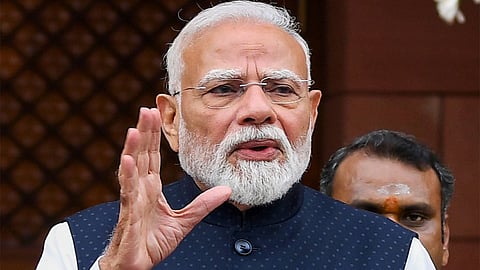
Prime Minister Modi on Sunday (July 26, 2026) announced the constitution of a high-powered task force, to recommend steps to make the country’s examination system leak-proof and technology-driven.
What became of the 2024 reforms?
Following the NEET-UG 2024 controversy, the Centre accepted all 101 recommendations submitted by the High-Level Committee of Experts (HLCE) headed by former ISRO chief Dr K Radhakrishnan. The committee had proposed transforming the National Testing Agency (NTA) into what it described as a "nimble, zero-error, adaptive and integrative" examination body. Its recommendations were divided into 60 short-term and 41 long-term measures, covering examination security, governance reforms, technological safeguards, and institutional restructuring of the NTA.
Several recommendations were implemented over the next two years. The NTA introduced Aadhaar-based biometric authentication, expanded CCTV surveillance and AI-based monitoring at examination centres, increased the use of government institutions as test centres, better coordination with states, and created new senior-level positions within the agency. The Centre also established a High Powered Steering Committee under Dr Radhakrishnan to oversee implementation.
However, progress on deeper structural reforms has been slower. According to recent analyses, 57 of the 101 recommendations have been fully implemented, 10 partially implemented, while 27 remain pending. Three recommendations are currently under implementation and four have been announced but are yet to be rolled out. Most of the pending measures relate to long-term reforms, including the transition to computer-based testing, strengthening information security systems, expanding AI-based monitoring and redesigning the architecture of high-stakes examinations.
The Supreme Court has also expressed dissatisfaction with the pace of reforms. During hearings on the NEET-UG 2026 controversy, it described the continued "ad-hocism" within the NTA as "troubling" and stressed that examination reforms must become institutional rather than reactive. The Centre, in turn, informed the Court that it was finalising measures that would go beyond the recommendations of the Radhakrishnan committee.
Who is on the task force and what will it do?
The six-member multidisciplinary task force is chaired by Infosys co-founder Nandan Nilekani, who previously led the Unique Identification Authority of India (UIDAI) and oversaw the rollout of Aadhaar. Other members include former ISRO Chairman Dr S Somanath, former Intelligence Bureau Director Tapan Deka, IIT Madras Director Prof V Kamakoti, former School Education Secretary Anita Karwal, and Amrit Lal Meena, Secretary in the Ministry of Road Transport and Highways.
The panel has been tasked with recommending long-term reforms to strengthen the National Testing Agency (NTA). Its mandate includes improving examination governance, plugging systemic vulnerabilities, expanding the use of secure digital technologies, strengthening cybersecurity, and ensuring that public examinations are transparent, efficient and resistant to malpractice.
What changes does the Amendment Bill propose?
Alongside the task force, the Centre has also moved to strengthen the legal framework governing examination malpractice. Introduced in the Lok Sabha this week, the Public Examinations (Prevention of Unfair Means) Amendment Bill, 2026 proposes significantly steeper penalties for paper leaks and other offences. Individuals found guilty could face imprisonment of up to 10 years and fines of up to Rs 50 lakh, while organisations involved may be fined up to Rs 5 crore and barred from conducting public examinations for eight years. In cases involving organised crime or syndicates, penalties could go up to Rs 10 crore. The Bill also proposes special fast-track courts and time-bound investigations to ensure quicker prosecution of offences.
Changes within the Education Ministry
The reform push has coincided with a wider reshuffle in the education establishment. On July 23, Vineet Joshi was transferred from his role as Secretary, Department of Higher Education, to the Ministry of Panchayati Raj, and Naresh Pal Gangwar was appointed as the new Higher Education Secretary. T K Anil Kumar also assumed charge as Secretary, Department of School Education and Literacy, following the retirement of Sanjay Kumar on June 30. Two days later, on July 25, Union Education Minister Dharmendra Pradhan resigned.
The same day, President Droupadi Murmu accepted his resignation with immediate effect, and Union Minister Pralhad Joshi was assigned additional charge of the Ministry of Education, alongside his existing portfolios. Joshi assumed charge on July 26 and will now oversee the rollout of the proposed legislative amendments and the implementation of the Nandan Nilekani-led task force's recommendations.
