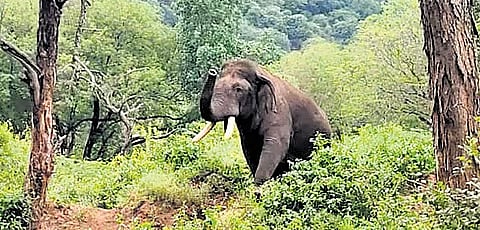

Many farmers across the western African nation of Gabon share the same grievance: waking up to trampled crops after nighttime raids by hungry forest elephants. The animals often seek out only the stems and leaves of banana and papaya plants and abandon the nutritious fruit, which lies broken on the ground. “That makes farmers even angrier, because they can’t understand why they just damage the fruits and don’t eat them,” says Steeve Ngama, a conservation scientist at Gabon’s National Center for Scientific and Technological Research, in Libreville.
According to a report in Smithsonian magazine, Asian elephants in Southeast Asia are known to eat certain plants when they’re ill as a kind of self-medication, and Ngama recalled research suggesting that banana and papaya leaves have medicinal properties.
In 2016 and 2017, Ngama worked with farmers to study crop-raiding elephants in several small villages in Crystal Mountains National Park, a rainforest-enveloped area near Gabon’s Atlantic coast. Ngama would follow the animal trails and collect dung samples along with samples from plants the animals had nibbled on. Later, scientists analyzed roughly 90 dung samples in a lab for evidence of gut parasites, such as worms. Having a parasitic infection, they concluded, made elephants 16 per cent more likely to eat banana stems and leaves and 25 per cent more likely to nibble on papaya plants.
Banana-leaf extract can kill the eggs of certain parasites in sheep, while the fluid in papaya stems can help control gut parasites in chickens. Ethnobiologist Jean-Marc Dubost points to experiments demonstrating that sick lambs can make associations between the healing effect of certain medicinal substances and their taste, and thus learn to seek out those plants during bouts of illness.
In Gabon, farmers often resort to violence to get rid of crop-raiding elephants, enlisting park managers or even poachers to kill the animals. But if elephants are given other sources of antiparasitic treatments — perhaps in the form of mineral salts — they might leave farmers’ crops alone, Ngama and his co-authors suggest.
Elephants in Laos reportedly eat the roots of the liana Harrisonia perforata when they have diarrhoea, for example, or roots and stems of the vine Tinospora crispa when they’re listless and have poor appetite. Female elephants chew certain roots during pregnancy, postpartum and nursing.

