

Chennai: India’s national flag may appear familiar to millions, but the story behind its colours and the Ashoka Chakra is one of evolution, debate, and competing ideas as the country takes shape.
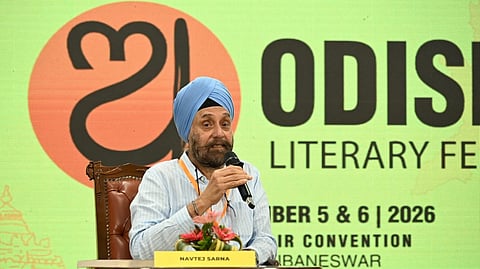
At the Odisha Literary Festival 2026, author and former Indian ambassador to the United States, Navtej Sarna took the audience through some of these lesser-known chapters of India’s history, drawing from his book A Flag to Live and Die For.
Responding to moderator Kaveree Bamzai’s question about the Charkha, Sarna explained how the symbol evolved from the Gandhi flag to the Swaraj flag and eventually the national flag adopted in 1947.
The Charkha, which had been part of the flag since the Swaraj movement, was replaced by the Ashoka Chakra at Independence. While Mahatma Gandhi was reportedly unhappy with the change, Sarna said the Constituent Assembly argued that the Charkha had not really disappeared.
“You see only part of it,” he said, explaining that the Chakra was also presented as the Chakra from Ashoka’s Sarnath Lion Capital. The change, he noted, reflected the transformation of the flag itself — from a symbol of resistance against colonial rule to that of a modern nation.
The discussion also brought attention to Pingali Venkayya, whose contribution to the evolution of India’s flag, Sarna said, remains much neglected. The early colours of the flag were given a communal interpretation, but this changed over time. By 1947, the Constituent Assembly had moved away from representing communities through colours and instead attached broader Indian values to them, including sacrifice, purity, detachment and growth.
For Sarna, however, history is not only about the events that become part of popular memory. It is equally about the stories that remain in the margins.
"History has got a huge canvas. Unfortunately, every period of time people begin to focus on certain stories. They become the big stories. But there are, you know, the footnotes of history, and each footnote is a huge history"
Navtej Sarna
That approach has shaped Sarna’s own writing, including his work on figures such as Maharaja Duleep Singh and his translation of Jaffar Nama, the Persian verse letter written by Guru Gobind Singh to Mughal emperor Aurangzeb.
He also spoke about his father, a Sahitya Akademi award-winning Punjabi writer, whose Partition stories inspired Sarna to translate 30 of them into English in Savage Harvest. Some of these stories are now part of the curriculum.
Asked about his current work, Sarna offered a lighter answer: “The easy way out for a fiction writer when he can’t attempt another novel, he writes short stories.”
