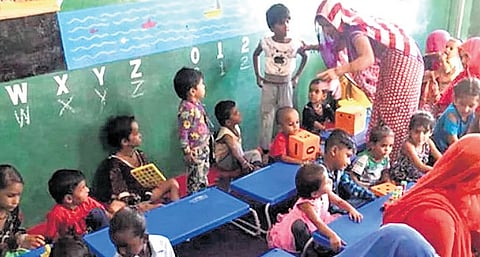

NEW DELHI: The Delhi government’s Department of Women and Child Development (WCD) has drawn up a plan to revamp more than 10,000 Anganwadi centres across the capital, reimagining them with improved layouts, child-friendly furniture, better learning tools, toys and more efficient use of space to strengthen early childhood care.
Recognising that infrastructure plays a critical role in early childhood development, the WCD convened a multi-stakeholder workshop at the Delhi Secretariat on Tuesday. The workshop brought together architects from the University Institute of Design and Technology, designers, academicians, NGOs and industry partners to explore practical and scalable solutions suited to Delhi’s spatial constraints.
A senior WCD official said the move comes amid persistent infrastructural and operational challenges. “Many urban Anganwadis function out of rented rooms in densely populated areas, often facing cramped spaces, poor ventilation, inadequate lighting and lack of outdoor play areas. Frequent relocation and high footfall further strain these centres, while workers manage multiple responsibilities with limited maintenance resources,” the official said.
During the workshop, suggestions included modular and prefabricated structures, as well as flexible, multi-functional furniture adaptable for different activities. Wall-based learning aids, portable play elements and foldable storage solutions were highlighted as cost-effective ways to maximise space and utility.
Climate-responsive design was another key focus, with proposals emphasising improved natural lighting, better ventilation and the use of sustainable materials.
WCD Secretary Dr Rashmi Singh said, “The idea is to create child-centric spaces that are not only functional but also stimulating, safe and inclusive. Beyond design, the initiative highlights collaboration. While the government will steer policy and implementation, architects will offer context-sensitive solutions, NGOs will provide community insights, and CSR partners are expected to support funding and scaling.”
She added that the next step is to pilot these ideas in select centres before expanding them citywide. “If implemented effectively, the initiative can transform Anganwadis into dynamic learning environments, strengthening service delivery and improving children’s health, nutrition and overall development,” she said.
At the core of this transformation is the SAMARTH Anganwadi initiative, which aims to convert these centres into vibrant, community-driven hubs. Built on a hub-and-spoke model, the programme will develop 611 model Anganwadi hubs with upgraded infrastructure and digital facilities, supporting a wider network of centres and covering all 10,897 Anganwadis in Delhi.
This story is reported by Ifrah Mufti

