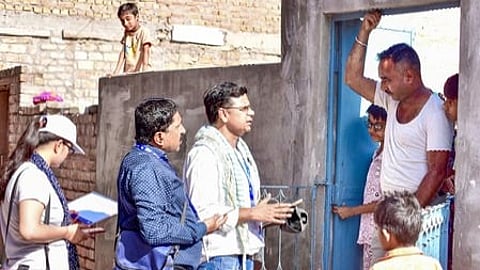


The Delhi government has been asked to consider granting 15 days of special earned leave to teachers and other teaching staff deployed for the first phase of Census 2027, following their engagement in house-listing operations during the summer vacation.
The proposal was moved by the Directorate of Census Operations, Delhi, which has sought the leave benefit for teaching staff assigned duties as enumerators, supervisors, charge officers, field trainers and charge clerks. The request has been forwarded to the Delhi government's Revenue Department for consideration.
Nearly 60,000 government officials, most of them teachers from Delhi government, Municipal Corporation of Delhi (MCD) and New Delhi Municipal Council (NDMC) schools, were deployed for the exercise, according to the official communication.
The house-listing and housing census operations were conducted in two stages. In NDMC and Delhi Cantonment areas, the exercise took place from April 16 to May 15, while operations in MCD areas were conducted from May 16 to June 14.
The personnel involved had to work throughout their summer break, including weekends and gazetted holidays, to complete the assigned work.
The proposal was discussed at a meeting of the State Level Census Coordination Committee on October 13, chaired by Delhi Chief Secretary Rajeev Verma. The committee recommended examining the possibility of granting special earned leave to eligible field functionaries, subject to applicable service rules and approval from the competent authority.
The Directorate has sought 15 days of special leave, citing the precedent of similar benefits extended to personnel deployed during Census 2011. The proposal is yet to receive final approval from the Delhi government.
What does the Census 2027 exercise involve?
The Census of India 2027 is being conducted in two phases by the Office of the Registrar General and Census Commissioner under the Union Ministry of Home Affairs.
The first phase, the House Listing and Housing Census, collects information on housing conditions, household amenities and assets. The second phase, Population Enumeration, records individual-level demographic, socio-economic, educational, migration and fertility information.
The first phase was scheduled between April and September 2026, with each state and Union Territory allotted a 30-day period for house-to-house operations and an optional 15-day self-enumeration window immediately before it.
The second phase is scheduled for early 2027 in most parts of the country. It will also include caste enumeration, following the Union government's decision to incorporate caste-related questions in the national exercise.
Census 2027 will be India's first census conducted through digital data collection. Enumerators will use mobile applications to record information, while a central Census Management and Monitoring System portal will facilitate monitoring and administration.
The Union Cabinet approved an allocation of Rs 11,718.24 crore for the exercise. Approximately 30 lakh field functionaries are expected to participate nationally.
Teachers have traditionally formed a substantial part of India's census workforce. Under the Census Act, 1948, appointed census officers and enumerators are required to carry out assigned responsibilities. The Union government has also stated that enumerators, generally government teachers appointed by state administrations, will undertake census work alongside their regular duties.
The proposed special leave in Delhi would recognise the additional time spent by teaching staff on the first phase, particularly those who worked during periods ordinarily reserved for their annual vacation.