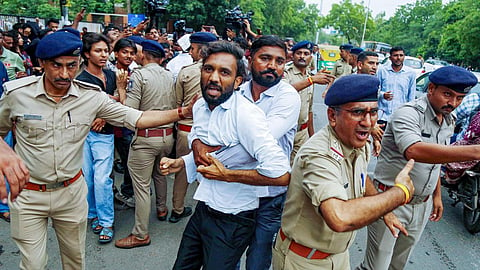

The Union government has rejected allegations that the biometric data of students who participated in protests against the National Eligibility-cum-Entrance Test Undergraduate (NEET-UG) examination was unlawfully collected and entered into national criminal databases.
In an affidavit filed through the National Crime Records Bureau (NCRB), the Ministry of Home Affairs (MHA) opposed a petition by Rajya Sabha MP A A Rahim, which raised concerns over the alleged use of Facial Recognition Technology (FRT) and biometric surveillance during demonstrations at Jantar Mantar in New Delhi.
The petition questioned whether the personal and biometric information of students participating in the protests had been collected, retained or shared without legal authorisation.
The Home Ministry described the allegations as sweeping and generic, stating that the petitioner had not identified any specific instance of an unlawfully collected biometric record. The government maintained that claims of the indiscriminate enrolment of protesters in criminal databases were not supported by specific evidence.
The NCRB also denied allegations that protesters’ data had been stored or processed through the National Automated Fingerprint Identification System (NAFIS) or the Crime and Criminal Tracking Network and Systems (CCTNS). It further denied sharing such data with private entities.
The affidavit clarified that the NCRB does not exercise direct control over data collection carried out by local police at protest sites. This distinction comes amid broader concerns about the use of surveillance technology during public demonstrations and the safeguards governing the collection and retention of personal information.
The case has brought renewed attention to the balance between law enforcement requirements and the privacy rights of students participating in peaceful demonstrations. Questions over the use of facial recognition systems and the possible long-term consequences of criminal records have also featured in discussions surrounding student protests.
Separately, the Supreme Court of India has intervened in cases involving NEET protestors. According to reports, the court invoked its powers under Article 142 of the Constitution to quash first information reports (FIRs) against peaceful student protesters, while allowing proceedings to continue against those with serious prior criminal records.
The developments have highlighted concerns about ensuring that participation in peaceful protests does not have disproportionate consequences for students’ academic and professional futures.

