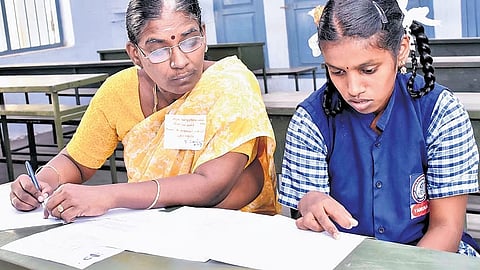

The Union Ministry of Education has released new guidelines requiring student teachers enrolled in recognised teacher education programmes to help five to eight non-literate adults acquire literacy skills and obtain certification under the ULLAS programme.
The guidelines for Teacher Education Institutions (TEIs) under ULLAS, or Understanding of Lifelong Learning for All in Society, were launched by Union Minister of State for Education Jayant Chaudhary on October 28. The programme, also known as the New India Literacy Programme, targets adults aged 15 and above who missed out on formal schooling.
Under the new framework, student teachers will serve as volunteer teachers, helping adult learners develop foundational literacy and numeracy skills. Academic credits will be linked to the successful certification of the learners they support.
The guidelines apply to students enrolled in programmes recognised by the National Council for Teacher Education (NCTE), including Bachelor of Education (BEd), Bachelor of Physical Education (BPEd), Master of Education (MEd) and Master of Physical Education (MPEd), among other recognised courses.
Roles assigned to teacher education institutions
The guidelines set out responsibilities for institutions and agencies involved in implementing ULLAS, including NCTE, the National Council of Educational Research and Training (NCERT), State Councils of Educational Research and Training (SCERTs), District Institutes of Education and Training (DIETs), State Literacy Mission Authorities and district administrations.
Teacher education institutions will help mobilise student volunteers and support the delivery of literacy programmes. The framework also seeks to coordinate the work of national and state-level education bodies so that learners can be identified, taught and assessed.
The guidelines were developed by the Department of School Education and Literacy after consultations with stakeholders, according to the ministry.
ULLAS covers reading, numeracy and practical life skills
Launched in 2022, ULLAS aims to provide learning opportunities to adults aged 15 and above who did not receive formal education. It combines online and offline teaching and relies on volunteers to reach learners in communities.
Beyond reading, writing and arithmetic, the programme covers financial, digital and legal literacy, health awareness and other critical life skills. Learning materials are available through the ULLAS mobile application and the Education for All section of the DIKSHA platform, including resources in regional languages.
Learners are assessed through the Foundational Literacy and Numeracy Assessment Test (FLNAT). Those who meet the required standard receive certification, allowing the programme to track progress beyond participation in classes.
The scheme has a budget of ₹1,037.90 crore for the 2022-23 to 2026-27 period and aims to cover five crore learners. Government data published in September 2026 recorded around 4.03 crore registered learners, more than 52 lakh volunteers and over 3.3 crore learners who had taken the assessment test.
Teacher trainees have previously been encouraged to volunteer
The new guidelines formalise the role of teacher education institutions in the adult literacy programme. In October 2024, NCTE held a workshop to encourage students and faculty from recognised institutions to volunteer for ULLAS.
At the time, the council said students participating in the initiative could receive two credits for community engagement and service. More than 18,000 teacher education institutions, faculty members and student teachers took part in the induction session.
The latest guidelines specify that each student teacher will be responsible for helping five to eight non-literate learners achieve certification. The ministry has not specified in its announcement when institutions must begin implementing the new framework.

