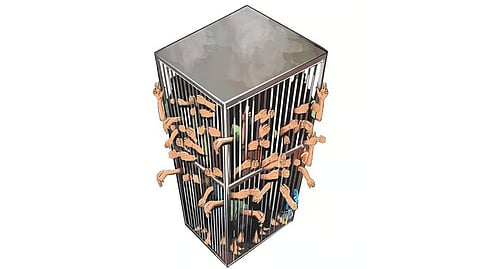

BENGALURU: The special home for children in conflict with law (CCL) in the city is seeing an unprecedented increase in admissions since the end of last year.
"The special home has 68 inmates aged between 14 and 22 years, the highest so far, since its inception 15 years ago in 2011. The sanctioned capacity is 50 inmates," said Dr Antony Sebastian, founder, executive director, ECHO (Empowerment of Children and Human Rights Organisation), a non-profit organisation which manages the Bengaluru-based Government Special Home for CCL.
The increase in the number of CCL in the special home is a disturbing resonance of the recent National Crime Records Bureau (NCRB) 'Crime in India 2024' report, according to which there is an uptick in crimes by juveniles (CCL) by 11.2 per cent in the country. "Since December last year, the numbers have been steadily increasing at the special home in Sumanahalli centre. There were 55 inmates in December.
The number went up to 58 in January, 61 in February, and by April-end, we had 68 inmates. We have written to the Department of Women and Child Development (DWCD), requesting them to increase the capacity and supporting infrastructure, including staff, in the special home. There is staff shortage and it is a challenge to handle the increase in the flow of admissions," he added.
Besides the increase in admissions, the number of drug-related 'convictions' is also of serious concern. "Of the 68 inmates, 10 to 15 boys in the age group of 17-21 years have been 'convicted' for heinous crimes; 20 boys aged between 14 and 18 years have been 'convicted' under the Protection of Children from Sexual Offences (POCSO) Act, 2012. Some of them are fathers, which has attracted a three-year sentence under POCSO," said Superintendent, Special Home, Biju PT.
"Under some tribal practices in Karnataka, children aged between 15 and 16 years choose their life partners. This gets them in the crosshairs of law," he explained. "We are also seeing more number of CCL 'convicted' under the Narcotic Drugs & Psychotropic Substances (NDPS) Act, 1985, in the special home. We have 15 CCL under the NDPS Act at present. It is a disturbing trend. Earlier there were nil to a few drug-related cases," said Sebastian.
"In our experience, we find that almost 98 per cent of children who come into conflict with law are from brutal, disturbed and vulnerable socio-economic family backgrounds, where they have faced extreme physical and mental abuse, neglect, trauma and deprivation. They are initiated into drugs and crime by adults, who later use them to peddle drugs and commit heinous crimes such as rape and murder," he explained. "Every CCL is a child who would have been in need of care and protection at some point in their life and was neglected or abused," he added.
A CCL is a child below 18 years who commits a criminal offence. In India s/he is tried under the Juvenile Justice Care & Protection (JJ) Act, 2015, by the Juvenile Justice Board. Maximum sentence under the JJ Act is three years of rehabilitation in a special home. The ECHO centre in Bengaluru is the only special home for CCL in India, which is managed by a non-governmental organisation (NGO).
It was set up in 2011 under the JJ Act and provides a holistic approach in reforming and rehabilitating CCL through education, vocational training, farming, horticulture and community based programmes. The special home is completely funded by the state government and is sanctioned Rs 3,000 per inmate per month, which includes education, board and lodging, medical expenses etc for a maximum 50 inmates.
This story is reported by Bala Chauhan

