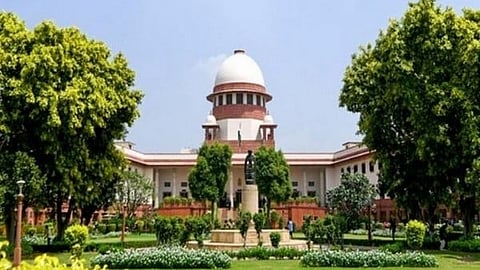

New Delhi: The Supreme Court on Monday voiced its concern over the Bar Council of India granting recognition to certain law colleges running from places like garages, criticising the council's stand for opposing the enrolment of a law graduate as a lawyer because of a pendency of a criminal case against him.
A bench of Justices Vikram Nath, Sandeep Mehta and R Mahadevan was hearing a petition filed by K R Sudersan, a chartered accountant, who later obtained a law degree but was denied enrolment as an advocate by the Bar Council of Tamil Nadu and Puducherry because a criminal case was pending against him.
"We can allow it right now. The order is completely against the law," the bench told senior advocate S Gurukrishnakumar, who was appearing for the BCI.
When the senior lawyer submitted that there was a "larger concern", Justice Mehta responded by saying that the real larger concern was the BCI granting recognition to colleges that are run in garages.
"The Bar Council of India granting recognition to colleges that are run in garages is the actual larger concern," Justice Mehta said, adding that the BCI was "enrolling convicts right, left and centre in the entire country".
Senior advocate Nikhil Goel, appearing for Sudersan, submitted that the petitioner had challenged the full bench decision of the high court before the top court as well as had filed a writ petition seeking his enrolment as a lawyer.
He said that the Madras High Court has since referred the issue to a bench of five judges.
"I am a 50-year-old chartered accountant. The allegation against me is that I advised a company which was involved in financial irregularity.
"They are opposing my enrolment tooth and nail. As an interim measure, let me be enrolled. When the five-judge bench decides the issue, we don't know," Goel submitted.
He sought interim relief from the bench and pointed out that one of the convicts in the assassination of former prime minister Rajiv Gandhi, despite having undergone 31 years of imprisonment, was enrolled as an advocate in April 2026.
Questioning the Bar Council's stand, Justice Mehta asked Gurukrishnakumar the reason behind the denial of enrolment to the petitioner.
Gurukrishnakumar referred to the high court's direction, while conceding that there was no provision for disqualification in the law just because a criminal case was pending against him.
Justice Mehta said such a restriction was outside the scope of Section 24A of the Advocates Act, 1961, which provides for disqualification.
The high court's single judge bench in 2015 directed the BCI to ensure that law graduates facing pending criminal cases were not enrolled as advocates.
A full bench of the high court in another case later affirmed the direction as a temporary measure to operate until Parliament amended the law.
Earlier this year, the high court's division bench referred the correctness of that view to a larger bench after observing that the Advocates Act, 1961 does not empower the high court to prescribe an additional disqualification for enrolment beyond those contained in Section 24A of the Act.
This report was published from a syndicated wire feed. Apart from the headline, the EdexLive Desk has not edited the copy.

