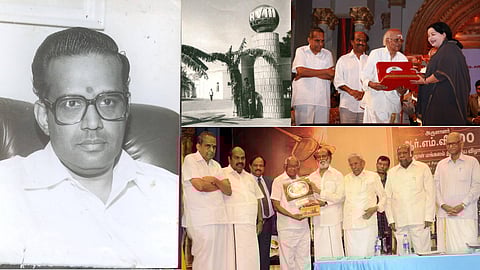

AVM Saravanan, one of India’s most influential film producers and co-owner of the iconic AVM Studios, is widely regarded as a pillar of South Indian cinema.
Known for his sharp instincts, commercial clarity, and commitment to mass storytelling, Saravanan has steered AVM through several eras of filmmaking—from family dramas to high-value star-driven blockbusters.
His production philosophy, rooted in understanding audience sentiment and adapting to changing trends, has yielded some of Tamil cinema’s biggest hits, including Samsaaram Athu Minsaaram.
The Nagi Reddy–Chakrapani National Film Award was presented to noted film producer and studio head AVM Saravanan, who received Rs 2 lakh, a memento and a citation in 2010.
Bharat Kalachar
M Saravanan, Sheriff of Madras, inaugurated the Bharat Kalachar, the cultural wing of the Bala Bhavan Educational Trust and the Padma Seshadri Bala Bhavan Schools in 1987 and emphasised the need for children to be accompanied by parents while viewing entertainment of any kind, noting that young audiences require guidance to cultivate good taste.
An interview titled, 'A lot depends on treatment and presentation: Saravana' was published in The New Indian Express on October 3, 1987, carried the following excerpts:

Samsaaram Athu Minsaaram (SAM) seems to have struck a deep chord with audiences. Were you expecting reactions of this sort?
Saravanan: Not at this scale. We heard stories that amazed even us—a man who watched it alone on the first day brought his entire extended family over the next four days because the film reflected their own joint-family dilemmas. A police officer even sent a quarrelling couple to watch the film so they might understand the give-and-take that keeps a family together. That kind of impact cannot be engineered. It happens when people see their own lives on screen.
Q: Even the censors reportedly took time with the film?
Saravanan: (Laughs) Yes, and not because they found fault. They were actually debating whether the heroine was right in wanting to break the joint family. Finally they came out saying, “No cuts — and congratulations.” When certifiers argue about the characters, you know the film has reached them. For a low-budget film like SAM, that kind of involvement is half the battle won.
Q: You also received national recognition for the film. How did that feel?
Saravanan: The President honoured us with a gold medal—the first ever for a Tamil film in that category. It was deeply satisfying because the award came on top of strong box-office collections. We’ve now tasted all-India recognition, though we are happy staying with regional films.
Q: SAM was made on AVM’s lowest budget in years. Why?
Saravanan: The video menace. If a film doesn’t recover money quickly, piracy overtakes it. We wanted a film that could earn back its investment fast. If SAM had released five years earlier, before video, it would have created an all-time record. If it released a year later, it might not have collected even half.
Q: How did the project originate?
Saravanan: Visu came to us with several stories—he had even tried action films then, which didn’t suit him. I insisted he return to what he did best: family subjects. When he narrated the SAM story, we approved it immediately. Only later did he reveal it had already been made once earlier—but poorly, which is why it disappeared in a few days. So we bought the rights. We reshaped the screenplay, added elements like Manorama’s character to widen the appeal, and treated it afresh. That is why I say: success depends on treatment and presentation. Persistence pays.
Q: Despite the success of SAM, AVM continues to make big-budget star films. Why?
Saravanan: Our studio workers must stay employed, and big films keep the machinery running. Also, formula hits are more profitable than an unusual success like SAM. The press may give glowing reviews to classy films, but at C and D centres audiences don’t care about technical brilliance. For example, Dharma Devathai did better than some highly praised releases. Even bad reviews don’t hurt mass films—Sankar Guru proved that.
Q: How do you design films for the masses?
Saravanan: We always look for an emotional undercurrent. In Sakalakalavallavan, it was a brother’s vow; in Paayum Puli, a sister’s murder; in Sankar Guru, a child’s search for his father. But nothing is guaranteed. We learned from Uyarndha Ullam that audiences didn’t want a hero who simply found contentment in poverty. So in Paer Sollum Pillai we made the hero fight back and become rich—yet even that didn’t work. Every lesson applies only till the next film.
Q: You’ve often spoken about video piracy. What should be done?
Saravanan: Remove the huge excise duty on additional prints. Right now we juggle with just 36 prints. A new release reaches a town like Mannargudi six months late—piracy takes over long before that. It hurts both producers and the government.
Q: Would AVM ever make art films?
Saravanan: (Smiles) If the rumoured increase in Doordarshan’s telecast rates for Panorama or award films happens—maybe Rs 15 lakh—we might be tempted. With that kind of revenue, we wouldn’t even need a theatrical release.
